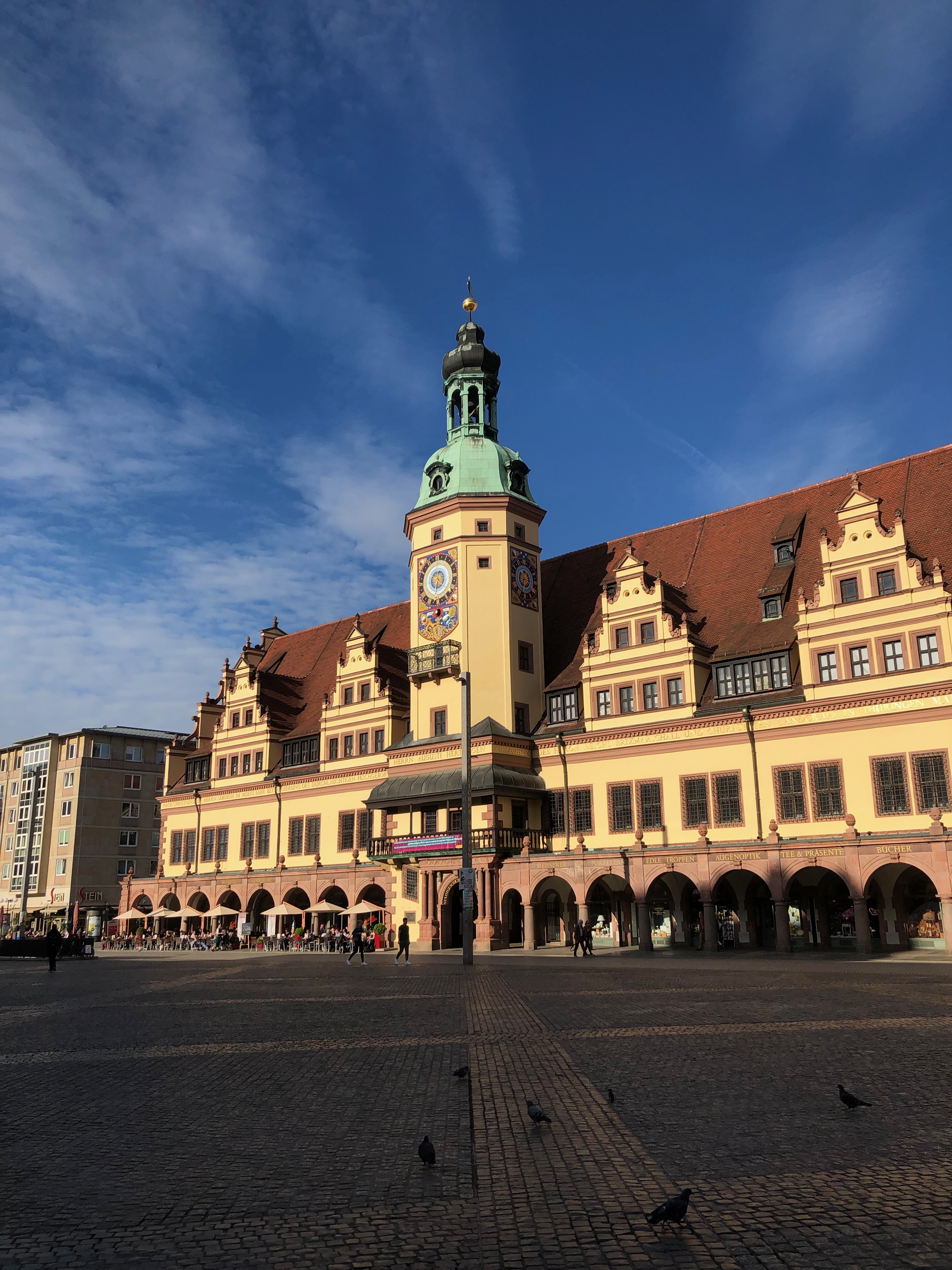
Das Alte Rathaus was formerly used as the city hall for Leipzig. Built in 1556, the facility has long been used for various events. The original architect for the building was the mayor at the time, Hieronymus Lotter. The most impressive part of the building is the large, octagonal tower that contains a clock on four of its sides. Upon doing some research on the elegant building, we discovered that the ballroom located in the building has hosted many royal weddings and festivals. Furthermore, the old prison cells still remain in the cellar of the building. Additions had been added onto the building, but it was eventually too small for governmental operations. Refurbishments on the building were carried out from 1906 to 1909. One of the rooms built during this time, the Hall’s treasure chamber, is still preserved today. Currently, the building serves as a museum of the History of the City of Leipzig. Within the museum, visitors have the chance to learn about Leipzig’s history in two separate parts. Part one includes history from medieval times up until the Battle of Leipzig in 1813. Part two contains information about modern Leipzig. Renaissance style furniture, paintings, and other household items are housed within the museum. One chair found within the museum, which formerly belonged to a mayor, contains the coat of arms of the city of Leipzig on the back. The most interesting part of the museum is the gallery containing portraits of the town’s magistrates. Burchard Berlich, Johann Friedrich August Tischbein, and Elias Gottlob Haußmann are some of the portraits are displayed.
Although we did not go into the museum, we explored the various shops located beneath the front arches of the building. Each small store was charming and specialized in different goods. Specific stores for tea, books, jewelry, and tourist gear can be found in the old city hall. We found the entire set-up quaint in the midst of a very populous and crowded area. The small shops located in such a traditional building made us feel as if we were in a fairytale. Every week, a farmer’s market is situated outside of Das Alte Rathaus, emphasizing the sense of community and importance surrounding this structure. I would definitely recommend spending time at Das Alte Rathaus and in Leipzig’s city center. The beautiful architecture and fascinating shops are more than enough reward for braving the tourist center of the city.
Walking into Treptower park is a walk that takes you away from the bustling city. Tall trees surround the grassy plain and line Bundesstrasse 96A. Walking further in, you’ll find a statue of a crying mother named “Mother Homeland”. Weeping willows trail the way to two stylized flags sculpted out of red granite that guarded by two kneeling soldiers. This mesmerizing layout leads out to a plateau that is a resting place for about 7,000 soldiers (the exact amount is unknown). On each side of this plateau are eight sarcophagi, each represent the 16 republics of the Soviet Union. The left side is engraved in Russian and the right in German. As you walk past each massive stone block, events of the Russian involvement in WW2 from 1941-1945 are etched on the side in marvelous detail along with words from Joseph Stalin telling the story of the Red Army’s sacrifice and triumph over the Nazi Army. At the end of the plateau stands a soldier crushing a swastika atop a hill holding a sword in one hand and protecting a child in his left hand. Below the 40 ft. soldier is a crypt featuring a mosaic depicting representatives of the 16 republics honoring the fallen.
I had no knowledge of this memorial in Berlin until Seth Howes took a group of us on a sudden whim. We saw other people there as well sitting around, having a beer, or reading the plaques. The size of this memorial was fascinating as well as its history. Construction of The Soviet War Memorial began immediately after the war and is one of three Soviet memorials located in Berlin. Designed by Yakov Belopolsky, it was completed on May 8, 1949. Shortly after the fall of the Berlin Wall, the memorial was found to have been vandalized with anti-soviet graffiti. It was announced that the vandalism was carried out by right-wing extremists and a protest was arranged on January 3, 1990. 250,000 Berliners participated in the anti-Nazi demonstration. As part of the Two Plus Four Agreement that created a unified Germany, Germany agreed to be responsible for the maintenance and repair of the monument. Since 1995, an annual vigil is held at the memorial on May 5 where the mayors of Berlin and Moscow place a wreath in the crypt.
The Semperoper, the opera house in Dresden, was by far the most beautiful performance space I have ever seen. For me, as a lover of music and theatre, this is a fairly profound statement since I have been to many professional theatre spaces in both the USA and parts of Europe. Located in the center of the city, the Semperoper is a clear focal point of historic Dresden and the presence of opera in the city. Inside and out, the building is devastatingly breath taking.
Pictured above: The Semperoper building
While in Dresden, I had the privilege to take a tour of this beautiful facility. The tour was accessible to tourists since an English version of the tour was available. During my tour, I heard stories about the composers who worked there, how the opera house was built, and the paintings on the ceilings. Interestingly, I learned that most of the marble inside of the opera house is not actually marble. Instead, it is an architectural technique more expensive than marble itself. Additionally, a painting inside of the main auditorium and above the stage depicts many famous characters in opera and theatre. Unlike anything I had ever seen before, I found this work of art one of the most captivating aspects of the opera house.
Notably, the composers Richard Wagner and Richard Strauss performed many of their works at the Semperoper. On my tour, I learned that Wager premiered many of his operas there. Some of Wagner’s famous premieres included the operas “The Flying Dutchman” and “Tannhäuser.”Today, the opera house is home to famous groups such as the Saxon State Opera, the Semperoper Ballett, and the Saxon State Orchestra.
The Semperoper, built originally in 1841 has a both rich and fascinating history. Built initially by the acclaimed architect, Gottfried Semper, the opera house was rebuilt later by his son. After burning down in 1869, the building was reconstructed again by 1878. I was surprised to learn that this was not the last time the opera house faced reconstruction. In 1945, the opera house was destroyed yet again by bombs during World War Two and was not actually completed again until 1985. Due to its baroque appearance, it is dizzying to realize that most of the structure is actually fairly new.
Taking the tour of the Semperoper is one of my favorite things I have done during this study abroad experience. Since embarking on this study abroad, I had wanted exposure to the obviously rich musical history surrounding me. My only regret is that I was not in Dresden long enough to see a performance there (as I was informed that one can buy a ticket for as little as $6!). I would highly recommend touring the Semperoper to anyone interested in music and theatre or even just architecture. I certainly hope that I can return some day and see an opera in this wonderful place.
Pictured above: Me living my best life at the beautiful Semperoper!
Dresden’s Gemäldegalerie Alte Meister is an art museum featuring pieces all the way back from the early 15th century. The museum in Dresden contains 750 paintings from the 15th to the 18th century. This includes major Italian Renaissance works as well as Duth and Flemish works. Walking around the museum, it was easy to see the influence that religion had on the art created in the 15th and 16th centuries. Almost the entire first floor was filled with paintings of the virgin Mary, newborn Jesus, and the nativity scene. It was also interesting to see the Greek and Roman influences. We walked through a room that was filled entirely of mythological sculptures.
A bust of Friedrich III, elector of saxony, protector of Martin Luther, and founder of the University of Wittenberg is shown in the 15th century art section. It is made from brass and was built by Adriano Fiorentino, one of the earliest and most important Italian portrait sculptures north of the Alps. The ”Tower of Babel” is dated back to 1595, by Marten Van Valckenborch. Most of Valckenborch’s works involved landscapes with religious themes as well as scenes of agriculture or mining. Marten would later develop towards a late Renaissance style, which is characterized by dramatic clouds and large mountains. An example of this is the “Tower of Babel”. The “Dresden Triptych” is dated back to 1437 and is a work divided into three sections called a “Triptych”. This work possibly intended for private devotion was created by Netherlandish painter Jan van Eyck. The work consists of an inner panel and two double-sided wings. The Museum only showed the triptych opened so that only three sections were able to be seen. When opened, the center panel shows Mary seated holding the Christ Child on her lap. The left panel shows Archangel Michael presenting a kneeling donor. The donor has yet to be identified, but there have been numerous suggestions such as a Genoese merchant. St. Catherine is shown on the right reading a prayer book. A wheel and sword is presented with her to signify who she is.
Unfortunately, we did not have enough time to see the entire collection, but the works of art that we did see were beautiful scenes from the Bible and landscapes around Europe. It is no surprise that over 500,000 people visit every year.
The World Clock is an iconic tourist destination that we felt was definitely worth seeing during our time in Berlin. It is located in Alexanderplatz among other popular tourist spots such as the Television Tower and an expanse of department stores. This makes it an optimal destination for tourists looking to experience the “must-sees” of Berlin.
Pictured above is the iconic World Clock. Behind it, the TV Tower can also be seen. This is a prime location for tourists in Berlin.
The idea to construct the clock came to be when the wreckage of the Uraniasäule (Urania’s Column), a street clock that sat in Alexanderplatz pre-World War 2, was found during restoration of the plaza in 1966. A contest was set up to create a replacement, and Erich John was the winner. Opened to the public on September 30th 1969, the World Clock is a truly unique and complex structure. The clock was designed by Erich John, but its construction required the help of more than 120 engineers and other experts to complete. It is 33 feet tall and weighs 16 tons. The clock is a constant reminder of the intense globalization present in the world today. It was constructed to reflect the 24 time zones (using UTC (Coordinated Universal Time)), each of which is listed circularly around it. Berliners and tourists alike can visit the World Clock and see the current time in 148 major cities. Above the listed times, a metal solar system sculpture made of steel rings and spheres revolves once a minute. The sculpture looks quite modern and is a further ode to the interconnected nature of countries around the world today. Another thing worthy of note is that it was not until some necessary repairs were made to the clock in 1997 that Tel Aviv and Jerusalem were added to the clock. Their initial omission was due to political sensibility surrounding Israel at the time.
We had learned about the World Clock in German class and were interested to see the structure in person. For those looking for things to do in Berlin, we would recommend taking a few minutes to check out the World Clock while in Alexanderplatz.
Around the Spinnerei, where we took the tour with Brad, is where the Bandhaus is located. An area of regrowth and new development, the factories that dominated the district of Lindenau (also called Plagwitz) closed, and the area was devoid of activity until new economic development enlivened the area. Artists, innovators, and creative folks of all calibers have come into the community created by the Spinnerei and have spread in and around the area to influence places like the Bandhaus Leipzig.
Madeline: I will admit, I was nervous before we went to the doom metal show. I had listened to the band on Spotify beforehand and they sounded kind of scary, I was wondering whether I had made a mistake. Once we got there however, my sentiments changed. The crowd looked quintessentially punk; most were equipped with piercings of all sorts, tattoos galore, attire was primarily black with denim jackets adorned with patches of various metal bands to show their commitment to the scene, and men with long hair perfect for head-banging. They were all so beautiful. Once the first group, Calliophis, started to play– I was in love. They were intoxicating.
Luci: I agree. I had come only to see Leechfeast, the band I’d listened to all semester while studying and had discovered eerie transcontinental connections with. However, I was entirely impressed with Calliophis. They were heavy and controlled, and had beautiful harmony. Also, that one time they just said “I hate, I hate, I hate, I hate, I hate…Jesus Christ” was funny. Standing right next to the speakers with the bass making my lungs shake until I coughed, being around familiar kinds of people who had antifascist and activist leanings (not only on their patches), was refreshing for my soul. Also, I met more people who like Chelsea Wolfe. Maybe she’s too popular to like anymore…(J/K). I hadn’t been to a good show in a while, and it reinvigorated my desire to produce music again, so that’s on my mind as I think about what to do when I get home.
Madeline: Luci knows the guitarist from the band Leechfeast, Jaka, and has connections with the lead singer, also named Jaka. We hung out with them, sitting on the concrete drinking a beer in front of the tour van before their set. They asked us questions about what we were doing in Leipzig, our other excursions in Europe, where we were from in the states, and what we planned to do after school. They were all from Slovenia. Jaka the guitarist told us he had a lot of family who immigrated to the U.S. In his family, anything they would call “amazing” or “great” is associated with the U.S. This struck Luci and I as bittersweet. We know things in the U.S. aren’t always peaches and cream, but it is projected as a great, rich land of possibilities to many countries around the world– although it does not live up to that image. Jaka then went on to tell us about his time touring in Detroit; he and a buddy were walking through the city and were shocked at how quickly a nice part of town they walked through became desolate and devoid of basic necessities less than two blocks farther away! Luci and I informed him that unfortunately that happens a lot in the U.S.
Luci: Yeah, dude. The United States is broken in so many ways, it is totally mind-boggling and infuriating. We don’t even have health care or, like, clean water in some places. End-stage decadent capitalism for the win?
The lead singer, Jaka, during the performance
Madeline: Cut to Leechfeast performing. It was amazing! Jaka the guitarist was impressive with his skills on guitar, and simultaneously the computer/keyboard station that was set up. Jaka the lead singer was incredible, with a screaming vocal range that was brutal combined with a more classical– almost chamber music-esque– singing voice that added a welcomed strangeness to the heavy soundscape. The bassist, Jurl, was so cool too. The performance was intoxicating, you were sucked in like a crazy intense meditation. It went by much too quickly!
Luci: Yo, you have hit on a really important point for me. That feeling of trance or meditation is one of the things I love most about doom metal, especially when it’s live. There are no mosh pits, there are no people showing off or proving their clout. It’s just a bunch of music lovers who have an intense connection with the droning…yeah, meditative…feeling of the music. “Shoegaze” is an offshoot genre of doom metal, and new doom is definitely pushing the boundaries of experimental genre-bending (like…what even is doom metal and what isn’t it?) with the addition of visual components like video compilations and soundscapes using prefabricated computer tracks. It’s pretty rad. I’m into it.
I thought our walk back to the apartment from the Bandhaus Leipzig was really fun, too. We were checking out graffiti, chatting about life and Germany, and then we had to decide whether to wait for a bus that might have taken 30 minutes to arrive. I’m glad we chose to walk, past the Baumwoll-Spinnerei and the canals, and groups of people out late just chilling on the sidewalks. It was nice. I’m so glad you went, Madeline. I look forward to calling you up when there is a great show in town at home and having some more fun experiences!
Memorial space to the people executed (sacrifices) there during Hitler’s dictatorship from 1933-1945
Plötzensee prison memorial is a space dedicated to political prisoners (and others) who were executed there by the National Socialists. It is a still-functioning prison in the Charlottenburg-Nord area of Berlin. Though it was constructed outside city limits in 1868, the area has since expanded to include sprawling residential and industrial areas. In the United States, prisons tend to be built in secluded areas, so I was struck by the proximity of prisoners and the free people living their busy lives directly outside the windows of the complex.
When the National Socialists took power in 1933 the prison system became an institution of violent deterrence, intended for the “eradication of inferior elements of the population”. Over half of the prisoners executed at Plötzensee were political dissidents who opposed the Nazi regime, most of whom were found guilty by the fraudulent Volksgerichtshof (People’s Court) under the jurisdiction of Roland Freisler, who was also a participant in the discussions about the “Final Solution” at the Wannsee Conference house. Unfortunately, violent repression was the response to those who opposed the National Socialists in any way. Punishable crimes were intentionally worded vaguely, and included ‘defeatism’, treason, owning banned literature, printing unsanctioned materials, etc. The regime used sadistic brutality to punish– and to deter– resisters, and that’s where the memorial is most affective.
The memorial, a bit of specific and obscure history, was completely empty of people except two construction workers fixing a pathway. The space is rimmed in high walls with razor wire, presumably to keep current prisoners from attempting escape (as an aside: it seemed rather cruel/ironic/absurd to allow modern prisoners to see the memorial from their cells). I walked into the “execution shed”, the tiny two-roomed building used to carry out the majority of executions. On the far wall were 8 meat-hooks, where thousands of people were murdered by increasingly barbarous means, including hanging a person from the hook using thin metal wire with their toes able to touch the floor, slowly and eventually causing death by asphyxiation or decapitation. In the adjacent room would have been where the guillotine was located (personally requested as a form of execution by Hitler in 1936 to replace the axe that had been used until then). Today there is only an ominous porcelain-tiled slab where the guillotine once stood, the ugly yellowish tiles contrasted against the rudimentary wooden shed walls created an effect that made it easy to imagine the horrific scenes that happened there.
To put the number of executions into perspective, during the 42 years between 1890 and 1932, approximately 36 convicts were executed at Plötzensee. Alternatively, during the 12 years of National Socialist rule, 2,891 people were executed, over half of whom were Germans. After air raids on Berlin destroyed the guillotine in June of 1943, the “Bloody Nights of Plötzensee” took place on June 7th-12th. Over 250 prisoners were hanged (using only the 8 meat hooks) without clemency proceedings. Six of them had not even been sentenced to death.
I have wanted to see the memorial at Plötzensee Prison since becoming interested in the minutiae of resistance to Nazis in Europe over a decade ago. At Plötzensee I sat for a very long time on the concrete floor thinking about the history of the place, and imagining/appreciating the risk and personal sacrifice it takes to oppose wrong in this world. These places of violence are sad, terrifying, and grotesque but they are also hopeful and inspiring. I wish this memorial was visited more often, because it seems to be slipping into an unfortunate obscurity.
Though I have written a rather long post already, I think it is important to portray these people as humans of varying beliefs and backgrounds, rather than only statistics. They all risked (and lost) their lives so that the world they lived in might be different and/or better. So, here are but a few examples of the thousands of political prisoners who were murdered by the Nazis at Plötzensee Prison.
Helmuth James Graf von Moltke Executed as one of the leaders of the resistance group “Kraisau Circle”, along with several others involved in the group’s non-violent opposition to Nazis. Graf von Moltke was able to write letters from a sub-prison of Plötzensee while he awaited his execution. Written to his wife, Freya and two sons, the letters were compiled and published by Freya after the war as the book “Letzte Briefe aus dem Gefängnis Tegel” (Last Letters from Tegel Prison”).
Helmuth James Graf von Moltke, defending himself in front of Roland Freisler’s People’s Court, to deaf ears. His guilt was predetermined and no defendants had access to attorneys.
Rote Kapelle (Red Orchestra) and Harro Schulze-Boysen Schulze-Boysen and his wife, Libertas, were well-positioned and influential in the Nazi party. They risked their lives by collecting photos and documents for the Allies about the atrocities of the Final Solution, distributing leaflets about Nazi crimes on the Eastern Front, and passing information on German troop movements to leaders in Moscow. The Gestapo discovered the resistance group by intercepting one of these communications. The meat hook method was imagined and developed specifically as an especially torturous death for Schulze-Boysen and seven of his friends. Over 50 members of the group, ranging in age from 16 to 70, were murdered on December 22, 1942 by hanging or guillotine for “conspiracy to commit high treason”.
Schulze-Boysen and wife Libertas. Their wedding was attended by HermannGöring.
Schulze-Boysen in his Wehrmacht uniform after arrest.
Liselotte Herrmann Liselotte was a member of the German Communist Party (KPD), and was expelled from Berlin University as a communist in 1933. During 1934 she worked at a munitions factory and passed sensitive and crucial information about arms manufacturing to the KPD central committee in Switzerland. She was murdered at Plötzensee in 1938 at age 28 for “treason and preparation for high treason”.
Karlrobert Kreiten Kreiten was one of the most influential and important German pianists of the time period. While on tour in March 1943, after the defeat of the German army at Stalingrad, he commented to a friend that the war was lost and that Hitler was “a madman”. He was overheard by an attendee, who turned him into the authorities. Roland Freisler sentenced him to death for “demoralizing the troops, aiding the enemy, and defeatist statements”, he was murdered in the execution shed at age 27.
After our group’s venture to the Spinnerei, we (Sean and Ben) broke away from our group as we needed to go to other places. We first visited a hat shop located there at the Spinnerei, and after perusing the shop we needed to go to Hauptbahnhof to find a bank. To get there we decided to walk to the starting point of the number 1 tram. Once we arrived there, rather than wait at the Leipzig-Plagwitz Bahnhof, the two of us decided to walk around and see the local area. We walked south from the Bahnhof, going through an area with some dilapidated buildings but also an active recreational area. Swings and a basketball court were being used and people were casually walking their dogs on the pleasant day. We continued south past these until we saw an amalgamation that looked as though it came from the world of Mad Max.
A construction made of haphazardly placed boards and everyday items stood towering over us as we neared. The name Bauspielplatz Wilder Westen marked a board on the entrance gate. This striking creation did not seem like an artistic piece placed by a local artist, and when we further inspected signs on the fencing its true purpose became known to us. The Bauspielplatz is a playground created for children, by children, with whatever items that can be found to use. Tires, ropes, wooden pallets, and even mud domes were present in the various areas of the playground.
Children who played on the site were able to form the playground to their own desire, creating a space that a child could consider their own. While the spielplatz did have some rules, such as children under six needing supervision by a 16 year-old or the banning of alcohol and tobacco there, generally there were not constraints as to what a child could do there.
(Sean) Armed with the promise of finding an off the beaten path graffiti coated walkway, we decided to opt out of a more comfortable tram ride to our apartment complex. Hidden in the forgotten surroundings of old dilapidated factories was a fenced off territory akin to the Lost Boys’ township straight out of Spielberg’s Hook. The phrase Bauspielplatz made out of tattered cloth and cord adorned the fencing like a proud badge. I immediately remembered an article I happened across explaining the origin and function of these creative play outlets.
Junk playgrounds are the borrowed term from Carl Theodor Sorensen’s imagined skrammellegeplads. These designated play areas came to be when Sorensen, a Danish landscape architect, observed that children insisted on playing everywhere save for the manufactured playgrounds. Junk playgrounds allow children a commissioned space where they are given all the tools necessary for engaging and creative play.
Harry Shier, author of Adventure Playgrounds: An introduction, defines these parks as an area where children can play freely, in their own way, in their own time. Continuing, what makes them special is that children can build and shape the environment according to their own creative vision. Rather than following the structure of calque terminology, the English language has instead adopted the more attractive term (to parents and local authorities alike) adventure playground.
On Friday, we visited the St. Alexis Memorial Church of the Russian Honor, located in central Leipzig, just a train stop away from Augustusplatz. The church’s golden tent roof caught our attention a few days earlier, and we knew we had to visit.
Designed by Vladimir Pokrovski, The Russian Memorial Church was opened in 1913, just before the start of the First World War. This church was built as a memorial to the fallen Russian soldiers in the Battle of Nations. The authorities of the city of Leipzig designated 2.5 hectares (25,000 square meters) at the edge of the battlefield for the Grand Duke Michael Alexandrovich and his committee to build the church/memorial. After ten months of building, it was consecrated just one day before the Volkershlachtdenkmal on October 17, 1913. The church is a replica of a church in Moscow, the Kolomenskoye. The architectural style was based on the style prominent in the Novgorod Republic. During World War 1, when Russia fought on the opposite side of Germany, the entrance of the church was walled and then the building was rented out to inhabitants of Leipzig; the building was also vandalized.
The church was very beautiful, albeit difficult to appreciate. There was a lot of writing commemorating the Battle of Nations, but it was all in Russian so it was impossible for us to understand. When we entered the church, we were struck by how small it was. The walls were very ornate, with a lot of icons of apostles and saints, gold, silver, the Virgin Mary with the infant Jesus, and adult Jesus. There were no pews, only an altar. It was also completely roped off, except for a small viewing area and a merchandise counter. No photos were allowed, and a recording of a boys’ choir played in the background. The church is clearly not meant to be functional, which was very disappointing.
Overall, we found the church to be quite beautiful to look at, but I didn’t see much point in it existing. It didn’t seem to be a church at all, but rather a memorial parading as a church. It doesn’t seem that the church holds services, but only exists for the people’s gaze.
On our last day in Berlin, we were walking towards the Memorial to the Murdered Jews of Europe on what seemed like a regular Friday afternoon. There were a few more people in the streets than we expected, but we chalked it up to tourism. However, turning around a corner, we were greeted by tens of thousands of kids. Children ranging from four or five years old all the way up into late teenage years filled the streets. Chanting and singing echoed throughout the street, and we were eager to see what they were so worked up about. Signs were held above the crowd saying things like “Wake Up Humans! You’re Endangered Too!” and “There Is No Planet B!!” Adults pushed toddlers in strollers and cops lined the march, making sure that peace was kept. It is also worth noting that the path of the protest passed multiple embassies, including the United States embassy. Due to the US’s lack of action climate-wise, it is likely not a reach to assume this was taken into consideration when the path of the protest march was chosen.
“Fridays for Future” is an active protest movement that is taking place in Germany and around the world. Every Friday in Germany, children in cities such as Berlin, Hamburg, Dortmund, Stuttgart, Cologne, and many more skip school to protest the lack of action regarding climate change. These absences from school seem to be supported by the kids’ parents, as many adults walked with their kids in the streets. We were overcome by the sheer number of protestors we saw last Friday. It became evident that this is an issue people are willing to fight for, and parents seem to support.
The start of these protests can be traced back to 2015 when an independent group of students invited peers around the world to protest on the first day of COP21, the UNFCCC Climate Conference. On November 30th, the first day of the conference, a strike was organized in over 100 countries with over 50,000 people participating. Their demands centered around 100 percent clean energy, keeping fossil fuel emissions down, and helping climate refugees (people who are forced to leave their home region due to sudden or long-term changes to their local environment). On August 20th 2018, Greta Thunberg, a Swedish ninth grader, decided not to attend school until the 2018 Sweden general election on September 9th after a series of heat waves and wildfires in Sweden. On September 7th of the same year, Greta grabbed national attention when she announced she would continue striking every Friday until Sweden opted into the Paris Agreement. It was then that she coined the Fridays for Future slogan. Students around the world were inspired by her actions and the movement began to spread. The movement has grown rapidly and is widespread today. On March 15th 2019, an estimated 1.4 million people protested in over 2000 cities and over 100 countries, signaling the strength of the movement.



 World History on the German Stage