Kulkwitzer See

Blog by Lizzie Wysession

We’ve been to Kulkwitzer See twice so far. Both times were absolutely lovely. Kulkwitzer See is a man-made lake in the South-west part of Leipzig. Originally, the area of the lake was an open-cast mine. However, once the geologic resources started to run thin, the area was shut down and restarted as a recreational lake.

Upon arriving, the recreational use of the lake became clear. There were boats of all kinds out on the water. People were playing music on speakers, swimming, eating, smoking, and generally having a good time. I would say the biggest culture shock for me personally was seeing the amount of nude bodies that walked the beach. It had been a while since I had been to a nude beach, and the realization of nudity being normal came in an intense wave for me. I had talked to my teacher in class previously about this topic. She called it “frei Körperkultur” which translates to “free body culture.” An especially surprising aspect of this was that most of the people participating in this clothing optional culture were elders, seeming to be 65 years or older. Adrianna and I took a walk down the beach on our first visit, and we walked right in to a pocket of about 30 elderly naked people. Although the sight of an old nude body isn’t a sight most people look forward to every day, the concept itself seemed quite interesting. I definitely wouldn’t be able to replicate the experience in the US, unless I were to go to  an actually mandatory nude beach.

Kulkwitzer See has much more to offer besides it’s nudity. The lake itself is not very large, and there is in fact another lake nearby that seems to be more popular and crowded. However, Kulkwitzer See is extremely accessible by transit, which is not something the other lakes in the area can boast about. All one has to do is to hop on the 1 Tram going to Lausen. Once you reach the end of the line and walk for maybe 5-10 minutes, you run right into the water. Kulkwitzer See is also perfect for those looking for a more relaxing afternoon. Although the beaches are anything but bare, it still isn’t so loud that falling asleep or reading a book in the sun would be impossible. I myself have taken a few naps there, and I would give the total relaxation vibe a score of 8.5/10.

Overall, I appreciate the nature and beauty that Kuhlwitzer See has to offer. The lake offers an escape from the everyday grind of monotonous jobs and careers. It is a place where families, friends, and loved ones can gather to celebrate life, or just to de-stress a little bit. It is no wonder the lake attracts so many people throughout the year.
A Glimpse at the Reichstag

Blog by Lizzie Wysession and Katy Troha

On our last day in Berlin, a group of us visited the Reichstag building for a short time. Unfortunately, we didn’t have enough time to go into the Reichstag, as we have to book the tours in advance. Nonetheless, we still had a good time from the outside in. The Reichstag is one of the most important and famous landmarks in Berlin. Construction for the Reichstag began in 1884 and consists of Renaissance, postmodern, and baroque architecture. Designed by Paul Wallot, the building stands in the center of Berlin and houses the German Bundestag. It was in use from 1894 until its destruction in 1933. The building was damaged by a fire and fell out of use after World War II. Instead of meeting in the Reichstag, the GDR parliament met in the Palast der Republik. The building was partially rebuilt in the 1960’s, but it didn’t go into full reconstruction until 1990, after Germany’s reunification. The Reichstag was finished in 1999 and it was once again used by the German Bundestag.

The architecture of the building was quite impressive. It features a large glass dome with a spiral staircase. The dome itself offers a 360° panorama of the Berlin cityscape. The dome is placed directly above the main parliament chamber. An electronic sun shield blocks the sun from blinding those in the hall. On the outside. six very large columns run parallel with the front entrance. Except for the dome, the architecture of the building could be described as a revival of Renaissance and baroque styled architecture. The strict contrast in architectural styles used on the building drew widespread criticism in the beginning, but the Reichstag has now been accepted as one of Germany’s prized landmarks.

Seeing the Reichstag was beautiful, and knowing how much history the building holds made the experience that much richer. We hope to return someday and fully explore the interior.

(Sincere apologies for the lack of visual stimulation- none of our pictures would upload lol)


Adventures in the Karl-Heine Canal

Blog by Lizzie Wysession, Madeline Knight, & Luci Cook

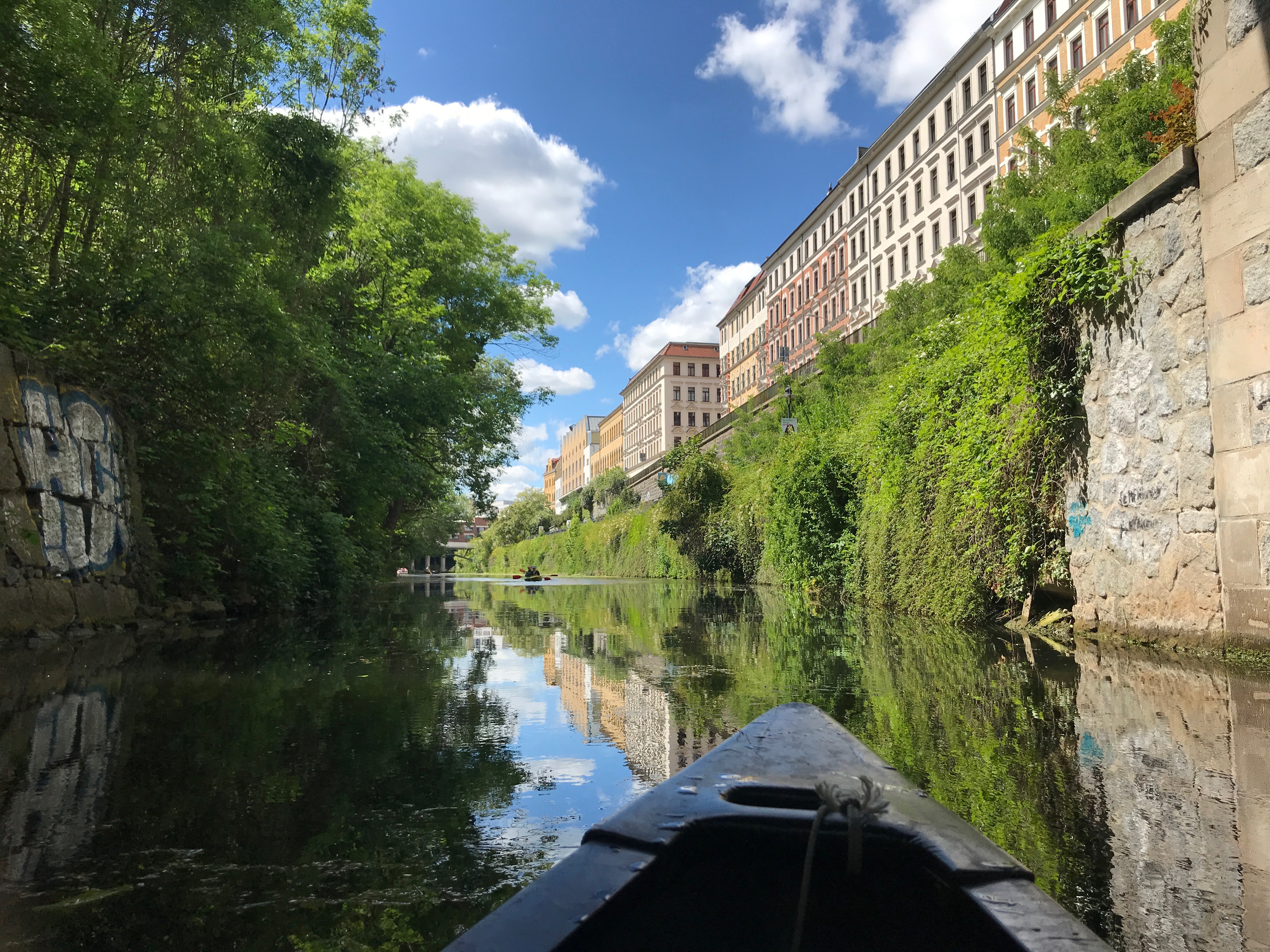
View From the Canoe

The floodplain of Leipzig serves as an important recreational area that creates a higher quality of life to the city residents. The Karl-Heine Canal is used by citizens for cycling, kayaking, walking and other sports and leisure activities. During the GDR times, the canal was misused as a sewer, which became an ecological disaster. It was virtually uninhabitable for plant and sea life that lived there and for the humans that nearby. In 2012, a revitalization of the floodplain area around Leipzig was undertaken to create better habitats for plants and animals and to maintain and increase its recreational uses for the people of the city. The revitalization project was a major success. While on the canal, one can see hundreds of fish below dense water ferns and lily-pads, many ducks napping or bathing in the sun, and even a few river otters! The canal appears to very healthy compared to how it might have been before 2012.

On a free day in Leipzig, we (Lizzie, Luci, and Madeline) decided to go canoeing down the canal by our apartments. On our trip, we noticed a plaque in the side of a bridge with Karl Heine’s name inscribed on it and the date, 1874. Karl Heine, January 10, 1819-August 25, 1888, was a lawyer and major entrepreneur in Leipzig. He studied law at the University of Leipzig and received his doctorate on the economic use of waterways and shores.

In 1854, Heine sought to expand his estate into Gemeinde-Plagwitz district of Leipzig. In 1856, he began construction of the first part of the canal connecting the White Elster and the Saale rivers. This construction ultimately led to the establishment of the western suburb of Leipzig. After hsi construction was completed and the western suburb of Leipzig was beginning to be established, Heine helped build up the economy most likely through his skills as an economist and through his canal. The plaque that we saw on our trip was probably worked into one of the bridges that he constructed to expand his estate, but we still don’t know what the year 1874 represents. If any of our subscribers know the significance of that year in relation to this canal, please comment below!

Though our trip only took us less than a kilometer from the canoe rental business, we were on the canal for nearly 4 hours. We leisurely paddled, eventually finding a rhythm that allowed us better control so as to avoid the heavy traffic of Gondolas and wave-making tourist boats. After a mini-excursion down a side-canal, we found a picturesque embankment and tied our canoe to a tree to have lunch. We ate a baguette with salami (and vegetarian salami for Luci), cheese, fresh strawberries and drank a bottle of wine. We talked of the canal and the sights we had seen. One thing that stood out to us was the amount of graffiti that covered the sides of buildings and bridges. It was fun to see all the different tags that people had left throughout the city, indicating the simple fact that they had been there before. The entire scene was picturesque and peaceful, and allowed us to see more of the nature Leipzig has to offer.

Paddling down the canal offers a sight into Leipzig that is far different than one could receive by simply walking through the city center. Although the paddling experience may be passed up by many tourists, we believe it to be an essential part of perceiving the city. The canal passed through many parts of Leipzig, tourist and native alike. Overall, we recommend the experience to all who travel here, and we hope to return to familiarize ourselves with more of the canal before we go home.

Fridays for Future

On our last day in Berlin, we were walking towards the Memorial to the Murdered Jews of Europe on what seemed like a regular Friday afternoon. There were a few more people in the streets than we expected, but we chalked it up to tourism. However, turning around a corner, we were greeted by tens of thousands of kids. Children ranging from four or five years old all the way up into late teenage years filled the streets. Chanting and singing echoed throughout the street, and we were eager to see what they were so worked up about. Signs were held above the crowd saying things like “Wake Up Humans! You’re Endangered Too!” and “There Is No Planet B!!” Adults pushed toddlers in strollers and cops lined the march, making sure that peace was kept. It is also worth noting that the path of the protest passed multiple embassies, including the United States embassy. Due to the US’s lack of action climate-wise, it is likely not a reach to assume this was taken into consideration when the path of the protest march was chosen.

“Fridays for Future” is an active protest movement that is taking place in Germany and around the world. Every Friday in Germany, children in cities such as Berlin, Hamburg, Dortmund, Stuttgart, Cologne, and many more skip school to protest the lack of action regarding climate change. These absences from school seem to be supported by the kids’ parents, as many adults walked with their kids in the streets. We were overcome by the sheer number of protestors we saw last Friday. It became evident that this is an issue people are willing to fight for, and parents seem to support.

The start of these protests can be traced back to 2015 when an independent group of students invited peers around the world to protest on the first day of COP21, the UNFCCC Climate Conference. On November 30th, the first day of the conference, a strike was organized in over 100 countries with over 50,000 people participating. Their demands centered around 100 percent clean energy, keeping fossil fuel emissions down, and helping climate refugees (people who are forced to leave their home region due to sudden or long-term changes to their local environment). On August 20th 2018, Greta Thunberg, a Swedish ninth grader, decided not to attend school until the 2018 Sweden general election on September 9th after a series of heat waves and wildfires in Sweden. On September 7th of the same year, Greta grabbed national attention when she announced she would continue striking every Friday until Sweden opted into the Paris Agreement. It was then that she coined the Fridays for Future slogan. Students around the world were inspired by her actions and the movement began to spread. The movement has grown rapidly and is widespread today. On March 15th 2019, an estimated 1.4 million people protested in over 2000 cities and over 100 countries, signaling the strength of the movement.

Blog by Lizzie Wysession and Kyle Hatten