Musik-Club SO 36

By Luci Cook and Elizabeth Messenger

Our first weekend in Berlin, we were invited by a friend of Luci´s to an event at Musik-Club SO 36. This Musik-Club has been around since the 1970s, and is an important part of the Kreuzberg community, particularly for traditionally underrepresented groups such as queers and im/migrants. Kreuzberg is a part of the city where residents and visitors can interact with different subcultures in a well-integrated atmosphere, as opposed to other parts of the city where some of these groups are viewed as a representation of the decline of German culture.

The name of the club, SO 36, is the old postal code for Kreuzberg. This is no coincidence as the club and its varying events reflect the diversity of the area. As a music venue, SO 36 naturally hosts all kinds of bands. Originally a venue for predominantly punk bands, it now also hosts metal, techno and pop, jazz, hip-hop, and many more genres, the club intentionally does not cater to just one demographic or subculture.

The venue is run cooperatively as the non-profit Sub Opus 63 e.V. So, in addition to music the venue also hosts many community-based events such as book and poetry readings, karaoke and bingo nights, flea markets and clothing swaps, dance competitions, drag shows, panel discussions, and so on. The club has recently been especially growing as a center for the queer community to hold events of all kinds.

The event we attended that night, Kuirfest, was not at all what we expected. Instead of a band onstage and a rowdy crowd, we found ourselves at the opening night gala for the 3-day film and culture festival. Kuirfest is organized in part by the Pink Life Lesbian, Gay, Bisexual and Trans (LGBT) Solidarity Association in Ankara, Turkey. It features films and events meant to support and make visible the LGBTQ Turkish community in Berlin.
That night, we had time for only one part of the opening night- Korospular, a radical queer choir. It is a queer/feminist choir started by activists and feminists in Istanbul. They reinterpret traditional Turkish songs through a queer lens and seek to create an atmosphere of solidarity through humorous (and well-done) music and singing performances that include audience participation.

Photographs are not allowed in the venue in order to protect privacy, but we don´t need photos to remember that night! It was a very fun experience and even though we are not citizens of Germany, Berlin, or Kreuzberg, we briefly witnessed the impact that intentional spaces such as SO 36 can have on the communities they serve.

Elizabeth and Luci in late night Kreuzberg


Kulkwitzer See

Blog by Lizzie Wysession

We’ve been to Kulkwitzer See twice so far. Both times were absolutely lovely. Kulkwitzer See is a man-made lake in the South-west part of Leipzig. Originally, the area of the lake was an open-cast mine. However, once the geologic resources started to run thin, the area was shut down and restarted as a recreational lake.

Upon arriving, the recreational use of the lake became clear. There were boats of all kinds out on the water. People were playing music on speakers, swimming, eating, smoking, and generally having a good time. I would say the biggest culture shock for me personally was seeing the amount of nude bodies that walked the beach. It had been a while since I had been to a nude beach, and the realization of nudity being normal came in an intense wave for me. I had talked to my teacher in class previously about this topic. She called it “frei Körperkultur” which translates to “free body culture.” An especially surprising aspect of this was that most of the people participating in this clothing optional culture were elders, seeming to be 65 years or older. Adrianna and I took a walk down the beach on our first visit, and we walked right in to a pocket of about 30 elderly naked people. Although the sight of an old nude body isn’t a sight most people look forward to every day, the concept itself seemed quite interesting. I definitely wouldn’t be able to replicate the experience in the US, unless I were to go to  an actually mandatory nude beach.

Kulkwitzer See has much more to offer besides it’s nudity. The lake itself is not very large, and there is in fact another lake nearby that seems to be more popular and crowded. However, Kulkwitzer See is extremely accessible by transit, which is not something the other lakes in the area can boast about. All one has to do is to hop on the 1 Tram going to Lausen. Once you reach the end of the line and walk for maybe 5-10 minutes, you run right into the water. Kulkwitzer See is also perfect for those looking for a more relaxing afternoon. Although the beaches are anything but bare, it still isn’t so loud that falling asleep or reading a book in the sun would be impossible. I myself have taken a few naps there, and I would give the total relaxation vibe a score of 8.5/10.

Overall, I appreciate the nature and beauty that Kuhlwitzer See has to offer. The lake offers an escape from the everyday grind of monotonous jobs and careers. It is a place where families, friends, and loved ones can gather to celebrate life, or just to de-stress a little bit. It is no wonder the lake attracts so many people throughout the year.

A Glimpse at the Reichstag

Blog by Lizzie Wysession and Katy Troha

On our last day in Berlin, a group of us visited the Reichstag building for a short time. Unfortunately, we didn’t have enough time to go into the Reichstag, as we have to book the tours in advance. Nonetheless, we still had a good time from the outside in. The Reichstag is one of the most important and famous landmarks in Berlin. Construction for the Reichstag began in 1884 and consists of Renaissance, postmodern, and baroque architecture. Designed by Paul Wallot, the building stands in the center of Berlin and houses the German Bundestag. It was in use from 1894 until its destruction in 1933. The building was damaged by a fire and fell out of use after World War II. Instead of meeting in the Reichstag, the GDR parliament met in the Palast der Republik. The building was partially rebuilt in the 1960’s, but it didn’t go into full reconstruction until 1990, after Germany’s reunification. The Reichstag was finished in 1999 and it was once again used by the German Bundestag.

The architecture of the building was quite impressive. It features a large glass dome with a spiral staircase. The dome itself offers a 360° panorama of the Berlin cityscape. The dome is placed directly above the main parliament chamber. An electronic sun shield blocks the sun from blinding those in the hall. On the outside. six very large columns run parallel with the front entrance. Except for the dome, the architecture of the building could be described as a revival of Renaissance and baroque styled architecture. The strict contrast in architectural styles used on the building drew widespread criticism in the beginning, but the Reichstag has now been accepted as one of Germany’s prized landmarks.

Seeing the Reichstag was beautiful, and knowing how much history the building holds made the experience that much richer. We hope to return someday and fully explore the interior.

(Sincere apologies for the lack of visual stimulation- none of our pictures would upload lol)


Memorial to Homosexuals Persecuted under Nazism

By Kate Lewis and James Brockenborough

In the Tiergarten of Berlin is the Memorial to Homosexuals Persecuted under Nazism.  Across the street from the Memorial to the Murdered Jews of Europe, a concrete cuboid is seen with a small window. In the window, a film of two men kissing is played on repeat. The feminist magazine EMMA protested that the monument should also represent persecuted lesbian women. As a result of this protest, the video now changes to two women kissing every two years. The erection was approved of the monument was approved by the Bundestag in December 12, 2003. A competition was held to decide who would design the project. Michael Elmgreen and Ingar Dragset both won the competition and subsequently designed the memorial. The project was completed on May 27, 2008. During the first year of its dedication, the memorial was frequently vandalized. Near the monument is a plaque that discusses the law that outlawed homosexuality. Paragraph 175, or Section 175, was a provision from 1871-1994 of the German Criminal Code that made homosexual acts between males illegal.

In February 1933, the Nazi party began to outlaw sex publications, purge homosexual clubs, and ban organized gay groups. Homosexuals within the Nazi party were murdered. In 1934, a special division of the Gestapo created a list of gay individuals that targeted 1,000,000 men. It is estimated that between 5,000-15,000 gay men were sent to concentration camps The rules were so strict, that a kiss was enough of a reason to prosecute someone. Offenders were castrated or sent to concentration camps. They died of disease, starvation, and abuse. While female homosexuality was not prosecuted, other than in annexed Austria, lesbians who came in contact with the regime were also subject to repressive measures. In 2002, the German government apologized to the gay community and the crimes committed against them.

Rebuilding and Reimagining Leipzig Through Music

A blog by: Kate Lewis and Sean Schofield

In anticipation of seeing the Gewandhaus-Quartette, we decided to do some research on the history of the Gewandhaus. The current Gewandhaus is the third of its kind. The first concert hall was built in 1781 by the architect Johann Carl Friedrich Dauthe. At the time, the hall was used as a trading hall by cloth merchants. This original purpose it how the hall got its name, Gewand is an outdated German term for garment. The first Gewandhaus, owned by the city of Leipzig, was located between Gewandgäßchen and Kupfergasse. The building also served at the city’s civic arsenal, containing the city’s ammunition and armaments up until 1828. The first dedicated concert hall was built within the building in 1781. The Gewandhaus Concert Board named the concert series “Concerts in the Hall of the Gewandhaus”. In this hall, audiences of up to 500 were able to see Mozart, Clara Wieck, Carl Maria von Weber, and Franz Liszt.

Around 1860, discussions about building a different concert hall. The new hall, owned by the Gewandhaus Concert Board, was finished in December of 1884 and sparked the evolution of Leipzig’s Musikviertel, or Music Quarter. The Neues Gewandhaus accommodated up to 1,500 audience members and had incredible acoustics. Some of the greats that played in this concert hall were Stravinsky, Tchaikovsky, and Richard Strauss. Unfortunately, the Neues Gewandhaus suffered a direct hit during the February 1944 bombing.

There were plans to rebuild the ruins of the second Gewandhaus; however, they concluded that the site would be demolished, and they would rebuild an entirely new Gewandhaus. The concert hall ruins would remain dormant for many years until its demolition in March of 1968. Following its demolition, the old site would be used as a parking lot until 2002 when the University of Leipzig opened a Humanities Center. Music didn’t simply stop during this time of rebuilding. They had to relocate and adapt to the new-found topography of Leipzig. The solution was to move the Gewandhausorchester performances to the congress hall in the city zoo from 1946 to 1981.

Starting in November of 1977, the construction of the first and only standalone concert hall during the Deutsche Demokratische Republik (DDR) was underway. The design was completed in 1981. Flaunting amazing acoustics, the main concert hall could seat 1900 aggrandized by a Schuke organ with 6845 pipes. The concert hall was christened on October 8, 1981 accompanied by the sounds of Beethoven’s 9th and Siegfried Thiele’s Songs to the Sun. Until early 2015 the Gewandhaus venue has been ticketing performances under two separate brand identities, the Gewandhaus zu Leipzig and Gewandhausorchester. It now identifies under the single brand of Gewandhausorchester and has been stripped of Gewandhaus zu Leipzig logos.

Spending Time Outdoors in Germany

By Elizabeth Messenger

It is easy to find a park or any other green space in Germany to relax in. Germans take their free time very seriously and spend a lot of it outdoors. They will go hiking in the mountains, kayaking in canals or rivers, bathe in the sun on the beach of a lake, or simply have a picnic in the park after work or school. Part of the reason outdoor activities are so popular here is that Germany isn’t known for having the sunniest weather on the planet so, when the sun does decide to come out, people take advantage of it. People also view time outdoors as a way to be healthy and spend time with loved ones at the same time.

Many Germans participate in interest-oriented clubs, such as gardening, hiking, or running. Not all of these clubs are based on being out in nature, but many of them are. This is how many people meet others with similar interests and form friendships. The nature oriented culture that is found in Germany allows people to form friendships, stay healthy, and explore their country. Leipzig is known as a very green city to be in. It is filled with green space and there is plenty to do if you love being outside and want to soak up the sunshine.

The main park in Leipzig is called Clara-Zetkin Park. It is very beautiful and is so big that you could probably get lost. The park is spread out around part of the Elsterflutbett river. Parts of the park feel like you’re walking through trails in a forest instead of a park in the middle of a city. Other parts are very manicured and provide space for people to lay in the grass or play with their dogs. It’s not uncommon to see people running along the trails, fishing or kayaking in the river, or just reading in the grass at all times of day. I really appreciate that Germans take their free time so seriously and that they spend so much time outside. When I get back to the United States, I plan on taking my free time more seriously and spending more time outside in nature.

My Experience in Germany

By Kate Lewis

While my experience in Germany so far has been mainly positive, I did experience some culture shock. Since this was my first time ever leaving the United States, I had no idea what to expect in another country. Add that to the fact that I had never flown before, and you could say I was a little more than nervous. My biggest fear heading into Germany was my inability to speak the language. I had no idea how I was going to get to the hostel in Berlin and would have no way to ask for help. Thankfully, people from the study abroad group were on my flight and we were able to navigate Berlin together. One of the first surprising differences I noticed was the bathroom situation. I couldn’t believe that you had to pay to use them.

Ordering food was also fairly different. At sit down restaurants, instead of receiving the bill from a waiter like in the US, you actually have to go up to the counter to pay. The food options in Germany are also very different. My favorite so far has been Döner, which I had never had before coming to Germany.

I was also surprised to learn about how seriously Germans take their free time. There are always lots of people in the parks, kayaking on the river, or walking their dogs without leashes! This aspect of German society has by far been my favorite. It is refreshing to see so many people relaxing and enjoying life outside. While little things, like putting money on the counter instead of in a clerk’s hand, are still a little strange to me, I am finally getting more comfortable staying in Germany.  Throughout my time in Germany I have been so thankfully to be surrounded by a good group of people who were willing to help me through getting used to German culture. Without them, there is no way I would have ever been comfortable staying in Germany. 

Navigating the Transportation System in Germany

By Kate Lewis and Elizabeth Messenger

Hauptbahnhof in Leipzig

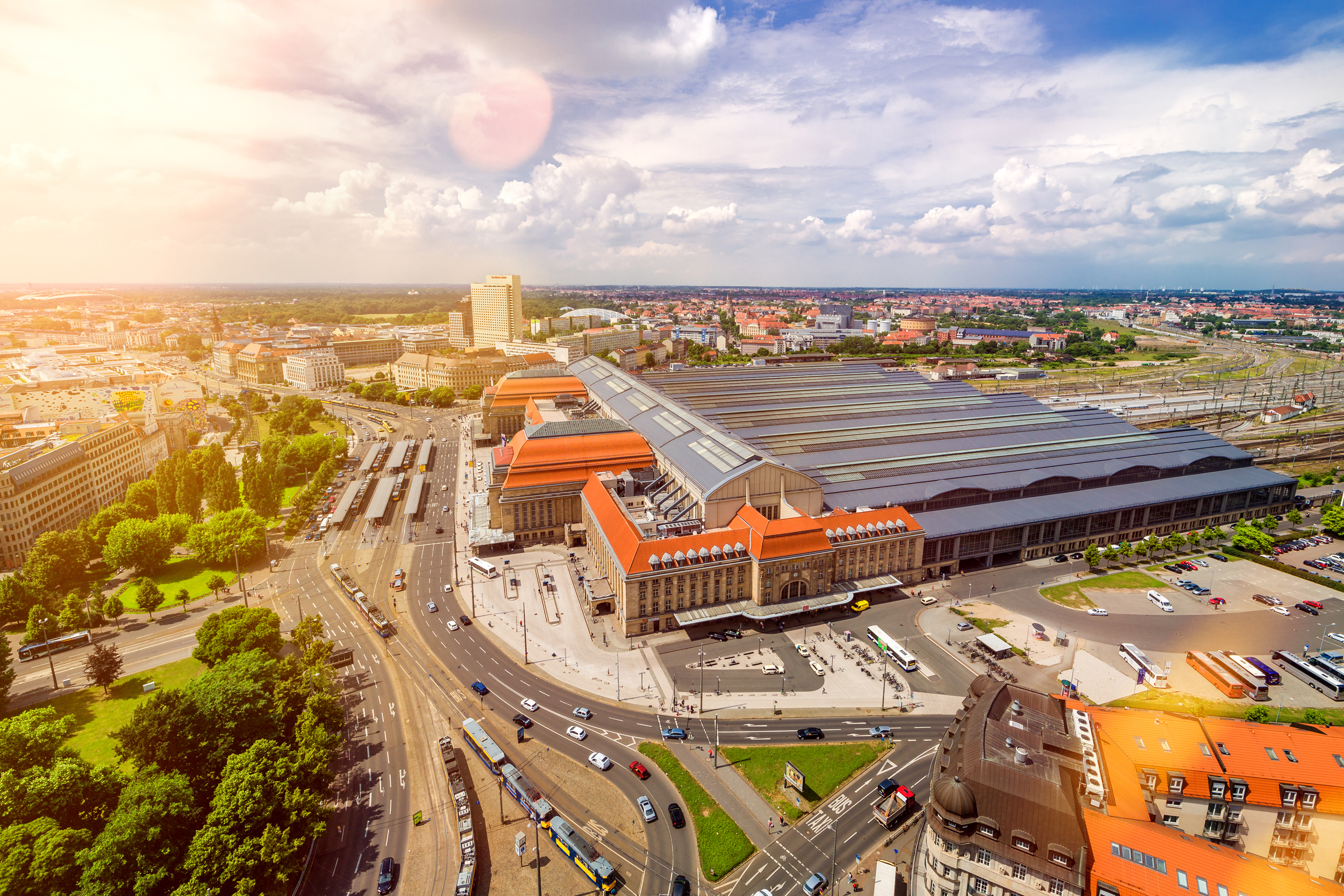
The public transportation system in Germany is excellent. And while the transportation networks can be somewhat confusing, they are expansive and can get you almost anywhere in the country. Even medium sized cities have good transportation networks. In both Berlin and Leipzig, transportation via train, bus, or tram has been fairly straightforward. Conveniently, a ticket bought for the S-Bahn can also be used for street cars and buses around the city. Unlike most other public transportation systems in the world, you do not have to verify your ticket before boarding. While this may tempt you to skip out on buying a ticket, you really shouldn’t.

Like many other practices in Germany, the train system is largely based on an honor system. People are expected to buy their tickets from machines and to validate them. After this, you can use the trains according to what is allowed on your ticket. No one checks your ticket. It is expected that you follow the rules because German society is based on rules. It only works because people take them seriously and follow them. That being said, there are people that do random ticket checks on the trains. They are dressed in plainclothes and tend to wait for the doors to shut before checking tickets. They do not take pity on tourists. Someone that knowingly rides trains without buying a ticket is known as a Schwarzfahrer. They are looked down upon because everyone else has bought their ticket and it’s inconsiderate for someone to think that they can get away with breaking the rules. The fine for not having a valid ticket is 50 euros for the first offence. Because not having a valid ticket is a crime, repeat offenders can be sentenced to time in jail. At some point in the 1980s, German students set up a Schwarzfahrer-Versicherung,or a fare-dodger insurance. If the students were caught, the insurance group would pay their fine. While there are similar schemes in other countries, this idea has not been extremely popular in Germany. Overall, the smartest thing to do would be to buy a ticket and not lose it. If you are looking to save some money, consider buying tickets in bulk and pay attention to the discounts available for weekly, monthly, annual, or group tickets.

Let’s Get This Bread

One constant between Berlin and Leipzig that made an everyday impact on our lives were the overwhelming amounts of bakeries throughout both cities. Every morning begins with a trip to the bakery for almost everyone in our group. This brought up the question for us: why are German bakeries so popular?

According to CNN Travel, “Germany doesn’t have the same amount of sunshine as southern France or Italy, and many areas are not conducive to wheat production, so grains such as rye and spelt tended to thrive better here and produced breads still consumed today. The wheat-based breads remained in the southern cities like Munich and Stuttgart.” Along with this, bread is a very substantial food item. Throughout history, German citizens from farmers to dukes relied on sourdough bread for sustenance. The practicality of bread as food mixed with Germany’s exact location make for a country with an intense love of bread.

            In Germany, bread is seen as an everyday staple. Bakeries are staffed with skilled bakers so that they are able to meet the high standards that are expected of them. Chains, like Starbucks or Dunkin Donuts, are not what most Germans visit everyday for their baked goods. Instead, they visit local bakeries that tend to be right down the street from their home or place of work. In these bakeries, one can find up to 3200 officially recognized types of bread-although this probably isn’t physically possible as bakeries tend to be small- and a Konditorei that serves cakes and pastries. The Konditorei is important for something known as “Kaffee and Kuchen.” In the afternoon, many Germans will take a break from their day and have a cup of coffee and a slice of cake to relax. It’s similar to British Tea, but better. Bread is an important part of everyday life in Germany and it is taken very seriously.  Because of this, we wake up every day excited to have breakfast because we know that it will always be a great experience to visit our local bakery.

Katy Troha and Elizabeth Messenger

Bistro Sinbad

By Sean Schofield and James Brockenborough

Bistro Sinbad is located on Zschochersche Straße in Plagwitz, Leipzig. Next to the Karl-Heine Kanal, it is, in our opinion, the best place to find döner. It is easily noticeable with its yellow and red sign outside. Walking in, you are immediately hit with the aroma of veal and chicken being slow cooked on a rack. A counter full of lettuce, cabbage, onions, and other vegetables greet you. A smiling face says hello and a menu across the ceiling shows all of the food to choose from. There are no wrong choices, but it is best to choose all of the sauces when asked.

As all great origin stories go, there are multiple perspectives on who or what came first, and the inception of the döner kebab is no different. The döner kebab and all of its variants: The Greek gyros, Arab shawarma, and Mexican al pastor are all adaptations that can be credited back to medieval cuisine in which a, preferably male, servant (spit-boy) would hand crank a wedge of meat on a rotisserie. The rotation of the meat cooks it evenly in its own juices. It wasn’t until the early 19th century Ottoman Empire that the advent of vertical rotisseries would impact the way meat is prepared and served. Vertical rotisserie applies heat directly to the side and is less important to balance the load. This is useful as the meat is shaved off on the side.

The location credited to where this vertical rotisserie was invented is split into two camps of thought. The more popularized understanding is that in the year 1850 a child, Ikender Efendi of Bursa, in what is modern-day Turkey, had the idea to cook the lamb upright in his father’s restaurant. This fact is often post faced with; however, his creation may have been predated as early as 1830 by Hamdi Usta of Kastamonu. It wasn’t until 1945 that modern day döner kebabs were introduced in Istanbul, later spreading to London in 1966 and Berlin in 1970.

Where there may be ambiguity in its origin, there is an untenable statistical certainty that the current adaptation of döner kebabs are a titan in the German food industry producing €3.5 billion annually. During my time in Germany through various exchange partnerships, travel, and study abroad semesters I have contributed more than I’d like to admit to the booming industry. There is a certain charm to the hospitable nature of these corner-shops where one may be greeted in a unique fusion of languages, and silly banter is often promoted.