Reichstag – New, but Worn

After visiting the Memorial to the Murdered Jews of Europe I knew I wanted to check out the Reichstag as it is nearby the memorial. As I walked to the Reichstag from the memorial, there was a large Fridays For Future (Student group that advocates for taking action to combat climate change) demonstration going on at the Brandenburg Gate, which is right next to the Reichstag. We had seen the actual full demonstration march earlier in the day and to see it was still going on a couple of hours later in the day was very impressive. I had already seen the Reichstag during my short trip to Berlin in 2015, but that did not make it any less impressive when I laid eyes on it again this time. It is a very large, interesting, and impressive building that can’t be missed. There were tourists everywhere around the building, and that came as no surprise. It is the second most visited attraction in Germany, trailing only the Cologne Cathedral.

Though one might guess that it is very old, it is actually relatively new compared to many other famous German and European landmarks. Completed in 1894, the building of the Reichstag was due to the recently unified Germany’s need to have a sufficiently sized place for their Parliament to meet. Having two architectural contests, one in 1872 and one in 1882, the winner of the 1882 contest, Paul Wallot, was the one whose design was used. Wallot’s design was directly modeled after Philadelphia’s Memorial Hall, which was the main building of the Centennial Exhibition (celebrated the 100th anniversary of the signing of the Declaration of Independence and was the first official World’s Fair to take place in the US) in Philadelphia in 1876. One major thing to note about the physical building is the inscription that it has at the top that was added in 1916, and reads “Dem Deutschen Volke” meaning to the German people, and thus is a symbol of democracy. Wilhelm II opposed its inclusion due to that symbol. The Reichstag housed Parliament until 1933 when the building caught fire and was nearly destroyed. It is important to note that the Nazi’s did not use the Reichstag for government purposes, but it gave rise to the power of Hitler and the Nazi’s. The fire happened four weeks after Hitler was named Chancellor. The Nazi’s blamed the fire on the Communists and stated that it was the Communists plotting against the German government. Hitler used this rhetoric to persuade President von Hindenberg to pass what would become known as the Reichstag Fire Decree, which suspended civil liberties and was the start to Hitler grabbing full power and control of Germany. The Reichstag remained generally unused from 1933 until 1999 when it once again became the meeting place for the German Parliament. It did undergo two long restorations though, one from 1961-1964, and one from 1992-1999. In the end, almost all of the inside was gutted and redone besides leaving some historical things such as some Soviet graffiti that was put there by Soviet soldiers when they captured Berlin in 1945, but the outside look remains the same. The dome on the top was added in 1999. The largest event to take place at the Reichstag was the ceremony for the reunification of Germany that took place on October 3rd 1990, and October 3rd is now German Unity Day celebrated annually.

Overall, though the Reichstag is not super old, it has seen an incredible amount of history during its time, and now stands as a symbol of a unified and democratic Germany.

By Kyle Hatten

Grünes Gewölbe

The Green Vault

Blog post by Kyle Hatten and Sean Schofield

During our day in Dresden, we had lunch by the river and when finished we had the opportunity to go see anything we wanted within the city center. We were intrigued by the vault and decided to go there. I don’t think either of us was anticipating the sheer number of unique items there were in the museum.

The beginnings of the Green Vault can be traced back to the year 1547 when elector Moritz of Saxony ordered the construction of an additional wing to the Residenzschloss Dresden(Dresden Castle). The new rooms that were built in this added section were painted green, and thus the Green Vault gained its name. For over 100 years treasures, jewels, and important documents were placed in the vault, but the vault was only that, a place where the rulers of Saxony placed valuables. It was not until between the years 1723 and 1729 that the private rooms were turned into a public museum. This decision was made by Augustus the Strong(Frederic Augustus I) who was the King of Poland and Elector of Saxony at the time. Having been a public museum since then, it is one of the oldest museums in the world. From the time it was first turned public in 1723 up until 1733, Augustus expanded the vault so it would fit all of his treasures. From then the vault remained the same all the way until 1938 when the treasures were moved to the Königstein Fortress (Saxon Bastille), which was a large hilltop fortification. The treasures were moved there for safekeeping as war was imminent. World War 2 would change the face of Dresden, as the city fell victim to intense bombardment. On February 13, 1945, three of eight rooms were totally destroyed, and the riches would later be relocated to the Soviet Union following the end of the war until their return in 1958. By 2006 the Historic Green Vault was restored to its former glory and opened for display with limited tickets sold daily.

Photo by Kyle Hatten depicting an ornate display casket used for housing sewing and writing utensils

The museum was structured in a way to take one through the ages represented through various gifts of ivory, opal, onyx, gold, silver, and precious crystals. The ostentatious assortment of the first exhibits establish a tone and welcomes one into the eras through visual stories representing the developing art styles and materials used during the time period. Contrasted with the authentically restored treasury rooms of the Historical Green Vault, the Neues Grünes Gewölbe is an extravagant selection of exhibits illuminated behind anti-glare glass in the comfort of state-of-the-art air conditioned rooms.

Photo by Kyle Hatten

Centrally located through the new treasury and armory exhibits is the prize jewel of the collection. The ‘Dresden Green diamond’ entered the collection in 1742 as a part of the cut diamond set. King August III of Poland acquired the 41-carat green diamond at the Leipzig Fair. This mysterious diamond has an undefined history of how it came to Dresden from India. Interestingly, its unique coloration is owed to the fact that the stone came into contact with natural radioactivity. In 1768 King August’s grandson, Frederick August III, commissioned the fabrication of an impressive agraffe boasting two large cut diamonds, of 6.3 and 19.3 carat, enveloped by an assortment of 411 small- and medium-sized cut diamonds that is currently on display.

Photo by Sean Schofield

All that Glitters, is basically Gold

Ornamental Tea Set, more than likely never used.

Getting to travel to Dresden was a fun excursion for a day. There were so many different museums, buildings, and history located in the city. One of the more interesting museums that we could visit was certainly the Grünes Gewölbe (Green Vault). Located within the Residenzschloss, the Green Vault shares the space with a quite massive collection of ancient coins and the Dresden Armory.

 The Vault is separated into two separate viewing exhibits, the Historisches Grünes Gewölbe and the Neues Grünes Gewölbe. Unfortunately during our time in Dresden, we were only able to peruse the Neues Grünes Gewölbe, which displays objects in a traditional museum style. The Historisches GG, on the other hand, displays its objects in the same atmosphere as was created originally by the curators.

Ornate Nautilus shell goblet with Red Coral emplacement.

 In the New Vault we were able to see exquisite and articulated items that were used or obtained for collection by aristocratic persons. Many of the pieces seen were heavily detailed and ornately decorated with gold, silver, and many precious jewels. The ‘Crown Jewel’ of the Vault would be the 41 karat Green Diamond. The diamond became that color because of natural radiation over time, and it is one of the largest and rarest of precious gems. Red coral was a material that was also used in some of the creations which was quite interesting to see being displayed in the Museum.

The Green Vault was originally founded by Augustus the Strong in 1723. The Green Vault is considered the largest collection of relics and treasures in Europe. The Museum itself is very large, containing over three floors worth of exhibits to view. There are exhibits that tailor to jewelry and home items, while other exhibits focus on the historical wars and the weapons that were either taken or given to the Green Vault.

Going through the Rüstkammer (Dresden Armory) was quite interesting as well, given that so many of the items and armor were so well preserved and ornate. The exhibit displays well over a thousand different artifacts and items, however that amount is only a fraction of the total amount of weapons, armor, and textiles in the Armory’s possession.

A set of jewels Ceremonial weapons and clothing fixtures

A separate area of the Rüstkammer is the Turkish Chamber. It contains many weapons either won or given from the Ottoman Empire and that region over time. There was a plethora of information to be found within the Residenzschloss and an afternoon does not merit enough time to fully explore the museum in its entirety. We had not enough time after viewing the New Vault and Rüstkammer to slowly go through the many coins that were in the exhibits. It would be interesting to be able to return to that museum and finish viewing the rest of these treasures.

By Ben and Kate

The Power of Sports

The somewhat sketchy entrance to the pool hall

The day we traveled from Berlin to Leipzig was DFB-Pokal Final day (final of the countrywide soccer tournament in Germany). The game was between Bayern Munich and the hometown RB Leipzig. We arrived in Leipzig in time to go to a local pool hall to watch the game take place. The pool hall was an amazing experience to watch a soccer game. Crowding into a chair and shifting into our seats, the tension and focus of the fans toward the screen could be felt in the air. Everyone around us was enjoying bar food and beer. After we ordered some drinks, the night seemed to coalesce into “Oh’s” and “Aw’s” coinciding with the action of the game.

We were in the front row of the hall so unfortunately you can’t see the crowd.

Bayern’s leading scorer Robert Lewandowski kicked off the scoring in the 29th minute, and with it waned some people’s spirits, but there was certainly still a feeling from the crowd that Leipzig could come back and win it. Bayern however, would go on to add two more goals(78th and 85th minute), but the crowd was into it the whole time, and the atmosphere was great. In terms of watching sports, the German soccer fans are certainly reminiscent of sports fans back home in some ways. Some more obvious than others, such as the love for alcohol and salty snacks or the fun pestering against the other team, but don’t take the fun pestering as a sign that they’re just joking around. When those players are on the field, their fans ‘bleed’ alongside them. There wasn’t a voice in that pool hall that didn’t yell out a remark in either joy or irk. In Germany, soccer is the biggest sport, and for most fans, the only sport. This is evident by the level of passion they have for it. It is not like the US where many sports fans have a favorite team in three or even more sports leagues. We were lucky enough to be able to go the same pool hall for the Champions League Final(final of the tournament between the best club teams in Europe) as well, and in going we saw further evidence of their love of soccer. The final was between two English teams (Tottenham and Liverpool), and despite neither team having a single German player, the pool hall was filled with people interested in seeing how the game played out. The way that soccer can bring cities together in Germany and their dedication to their teams is reminiscent and mirrors quite well the way St. Louis came together recently for the St. Louis Blues’s recent Stanley Cup run. Overall, it seems that the intense passion for sports is something you will see no matter where you go. The kind of sport may be different, but the passion of the fans will not.

By Kyle Hatten and Ben Kohlhaas

Brandenburger Tor: Nacht und Tag

by: Sean Schofield

(Brandenburg Gate: Night and Day)

Commonly the first stop for many tourists visiting Berlin, the Brandenburg gate towers a proud 26 meters tall, nearly 66 meters in length and 11 meters wide.  Its early construction between the years of 1788 and 1791 was a design credited to Prussian court architect Carl Gotthard Langhans. A Grecian inspiration may be recognized for travelers and historians familiar with Athens’ Acropolis gateway.  Aside from it’s inspiring size, the Quadriga statue that adorns the gate may be one of the most recognizable traits. 

The Quadriga, designed by Johann Gottfried Schadow, depicts Victoria, the goddess of victory, toted on a chariot driven by four horses. Following defeat in the battle of Jena-Auerstedt, the Quadriga was seized by Napoleon Bonaparte’s army, packaged, and sent to Paris where it was to sit in storage until the capture of Paris by the Prussians in 1814. The Quadriga would be shipped back to Berlin with the addition of a symbolic iron cross signifying Prussian victory over Napoleon’s army.

Concluding a long day of museum hopping, I found myself, with a fellow study abroad student, on one of Berlin’s inner-city tram rails with minimal daylight and some time to kill. We decided to take advantage of the free time, getting a sneak peak of future excursions, by visiting the Brandenburger Tor and the German parliament Reichstag building. Surprised to see the gate closed off for a charity run, we took to the streets making a loop and meandering through the town center. As the sun began to set, we made our way to a convoy of security and spoke with police officers who offered us a backdoor entrance into the otherwise exclusive grounds. Armed with a beer in hand we set path down the sidewalk, passing tents of straggling merchants closing shop, to the tune of various electronic remixes. We made base at picnic style benches in front of a memorably illuminated candied nuts and chocolate pop-up.

The Brandenburger Tor has been a powerhouse of historical significance. The gate was utilized in dark times as a rallying point for the Nazi cavalcade celebrating Hitler’s seizure of power on January 30th, 1933. The gate was also the backdrop for moments of redemption, such as Ronald Reagan’s famous decree directed towards Mikhail Gorbachev.

General Secretary Gorbachev, if you seek peace, if you seek prosperity for the Soviet Union and Eastern Europe, if you seek liberalization: Come here to this gate! Mr. Gorbachev, open this gate! Mr. Gorbachev, tear down this wall!

(madison 2012)

It was only two years following this speech that the gate saw record attendance for the dismantling of the Berlin Wall. Rejoicing just two months later marked the official reunification of Germany with conductor Leonard Bernstein conducting the German philharmonic in an adaptation of Beethoven’s 9th symphony replacing the “joy” in “Ode to Joy” with “freedom.”

The contrast of the gate’s light and dark history was even more realized with the spectacle of spending an evening watching the presence of this monument during heavy traffic in daylight into the powerful illumination of its figure in moonlight. I would strongly recommend planning a trip around being able to view monuments of this stature from all angles and lighting perspectives, as each stone has history laying dormant waiting to be actualized and tell its story.

Madison, Lucy. “Remembering Reagan’s ‘Tear Down This Wall’ Speech 25 Years Later.” CBS News, CBS Interactive, 12 June 2012, http://www.cbsnews.com/news/remembering-reagans-tear-down-this-wall-speech-25-years-later/.

Eine Pause in Prag

St Vitus Cathedral

When Luci was first describing how a visit to Prague, she talked about the town was ‘magical’ and as though being in Prague was akin to a fairytale. The ancient architecture stemming throughout the city emanates a feeling of being lost in time even though modernity has seeped into the cracks of the old facades. Red tiled roofs soak the cityscape, articulated fences and gateways dotted the walkways, and beautiful renditions of paint and stone were present in almost every facet of the town. The history of Prague seems to stem from a mixture of Orthodoxy, alchemy, and astrology as their influences can be seen in the artwork, history, and general layout of Prague.

 In the past the Czech Republic and Prague itself has had a complex relationship with Germany. When Nazi Germany was still expanding its borders, the country was annexed and turned into a source of military production for the German war machine. Remainders of German presence can be seen throughout Prague, as some buildings, signs, and placards throughout the city used the German language. This seems to differ slightly from the tourism aspect of Prague, where the restaurants and local attractions use the German language as well as many others.

On our first night in Prague we visited the Charles Bridge after doing some city walking and getting some food. The bridge was, as is most of the town, quite ornate and crafted from Bohemian limestone. On each side of the bridge are statues of different religious and historic icons that stretch along the bridge’s length. When Charles bridge started construction in 1357, legend rose that King Charles IV had laid the first brick himself. We chose to go to the bridge at night because the Charles bridge is supposedly haunted. While no apparitions or spirits came during our visit, the time spent there was effective for viewing a beautiful city and self-reflection.

Saint Statue on Charles Bridge, Photo by Katy.

While in Prague we visited some other places such as the Prague Castle. Climbing up the spiraling stairs had brought flashbacks to our earlier ventures at the Völkerschlachtdenkmal and the Frauenkirche. Succeeding in reaching the top of the Castle was very reminiscent of those ascensions and we were rewarded with a just as breathtaking view.Although we had not explored the city to its full extent, visiting Prague was something well worth the time and effort.

Take Me Home, Squatter Road

Graffiti has been a central part of ‘angsty’ rebellion for decades and can be found in almost any nook or cranny in the city of Leipzig. Tagging buildings, spraying signs, and larger graffiti works are thoroughly spread out through Leipzig. These acts of artistic rebellion do not have a sole purpose to deface buildings and disrupt what some would call ‘normal’ society, but rather a collection of personal expression and community all of its own. On one of my first days in Leipzig, a walk had given me the opportunity to see firsthand this alternative community out and about. Nestled between Gießerstraße and Naumburg Straße is a simple path towered on both sides with graffiti both old and new. The aging buildings are wildly decorated as well as the stone walls lining next to them. Some sections of the walls were treated as sole canvases, while other graffiti stretched and covered large areas of space. Vibrant colors, stylized lettering, and Alf were all on display for passersby.

For this area, the nearby stadtteil Connewitz, and Leipzig in general squatting has been a prevalent part of their history. Squatter groups have been in Connewitz since the early 1980s due to the allure of squatting’s illicit nature. In March of 1990 fourteen buildings in Stöckartstraße and the nearby area were successfully occupied. An association was formed during this time as well, called Connewitz’s Alternative, whose goal was neighborhood projects and legalization of the squatting areas. However the group did not last for a elongated time, rather infighting caused the collapse of it after an inability to decide protections against Neo-Nazi persons. This time period gave way to a change in the type of squatters, with sub-groups of people such as street racers or those who can be considered under radical left.

This shift in squatter milieu gave way to a confrontation in November 1992 in which police had used their firearms to deescalate the situation. This brought forth a myth that Connewitz was a den for militant criminals which placed pressure on authorities to take preemptive action against the squatters. The “Leipziger Linie” was the first iteration of a more understanding solution, as it allowed for contracts between the city and peaceful squatters but also noted the intolerance for criminal activity. Eventually the contracts allowed for some squats to be completely evicted and increased the difficulty to establish new squats in Leipzig. As a solution brokered between the city and the Alternative Wohngenossenschaft Connewitz, the AWC was given fourteen buildings that were purchased by the city in 1996. These buildings were the starting ground for collective living, and in conjunction with local clubs such as Werk II and Distillery, Squatters shaped the identity of Leipzig as a harbor for subculture. In more recent times activist groups have staged their own squatting such as the occupation of the Erziehungswissenschaftlitheche Fakultät, where around 80 people squatted wanting a “Social Center for All”.

While squatting is often seen as a negative aspect, my time spent in the area was all but negative. I had seen an expecting couple loading a large subwoofer box into the back of their vehicle, and in the open grass was a large group relaxing in the grass, conversing, and blasting out good vibes with reggae music. This small, seemingly decrepit area was buzzing with activity and teeming with life. There in that area lies a community with its own identity, and the culture from it stems outward and throughout the city. Seeing such a connected group of people was a cheerful sight to me. That shared want for community permeates from Leipzig, and to see something as that be so successful and continue to strength makes me exceptionally happy to have the opportunity to live in Leipzig and interact.  

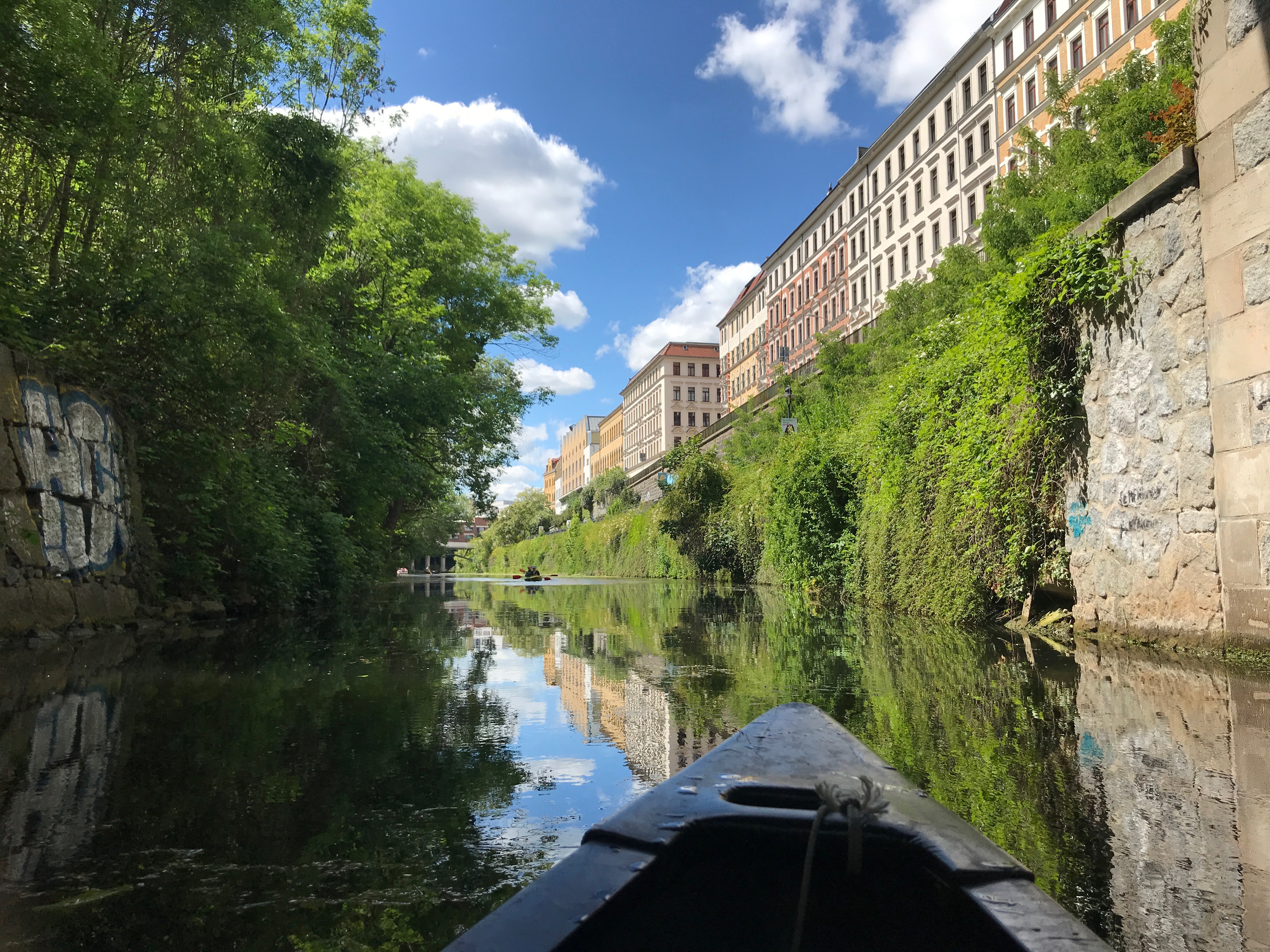
Adventures in the Karl-Heine Canal

Blog by Lizzie Wysession, Madeline Knight, & Luci Cook

View From the Canoe

The floodplain of Leipzig serves as an important recreational area that creates a higher quality of life to the city residents. The Karl-Heine Canal is used by citizens for cycling, kayaking, walking and other sports and leisure activities. During the GDR times, the canal was misused as a sewer, which became an ecological disaster. It was virtually uninhabitable for plant and sea life that lived there and for the humans that nearby. In 2012, a revitalization of the floodplain area around Leipzig was undertaken to create better habitats for plants and animals and to maintain and increase its recreational uses for the people of the city. The revitalization project was a major success. While on the canal, one can see hundreds of fish below dense water ferns and lily-pads, many ducks napping or bathing in the sun, and even a few river otters! The canal appears to very healthy compared to how it might have been before 2012.

On a free day in Leipzig, we (Lizzie, Luci, and Madeline) decided to go canoeing down the canal by our apartments. On our trip, we noticed a plaque in the side of a bridge with Karl Heine’s name inscribed on it and the date, 1874. Karl Heine, January 10, 1819-August 25, 1888, was a lawyer and major entrepreneur in Leipzig. He studied law at the University of Leipzig and received his doctorate on the economic use of waterways and shores.

In 1854, Heine sought to expand his estate into Gemeinde-Plagwitz district of Leipzig. In 1856, he began construction of the first part of the canal connecting the White Elster and the Saale rivers. This construction ultimately led to the establishment of the western suburb of Leipzig. After hsi construction was completed and the western suburb of Leipzig was beginning to be established, Heine helped build up the economy most likely through his skills as an economist and through his canal. The plaque that we saw on our trip was probably worked into one of the bridges that he constructed to expand his estate, but we still don’t know what the year 1874 represents. If any of our subscribers know the significance of that year in relation to this canal, please comment below!

Though our trip only took us less than a kilometer from the canoe rental business, we were on the canal for nearly 4 hours. We leisurely paddled, eventually finding a rhythm that allowed us better control so as to avoid the heavy traffic of Gondolas and wave-making tourist boats. After a mini-excursion down a side-canal, we found a picturesque embankment and tied our canoe to a tree to have lunch. We ate a baguette with salami (and vegetarian salami for Luci), cheese, fresh strawberries and drank a bottle of wine. We talked of the canal and the sights we had seen. One thing that stood out to us was the amount of graffiti that covered the sides of buildings and bridges. It was fun to see all the different tags that people had left throughout the city, indicating the simple fact that they had been there before. The entire scene was picturesque and peaceful, and allowed us to see more of the nature Leipzig has to offer.

Paddling down the canal offers a sight into Leipzig that is far different than one could receive by simply walking through the city center. Although the paddling experience may be passed up by many tourists, we believe it to be an essential part of perceiving the city. The canal passed through many parts of Leipzig, tourist and native alike. Overall, we recommend the experience to all who travel here, and we hope to return to familiarize ourselves with more of the canal before we go home.

The Grassi-Instrumenten Museum

By Adrianna Northrop and James Brockenborough

The Grassi-Instrumenten museum is a hidden gem in Leipzig that complements the rich musical culture that is abundant all around the city. Located just a short walk away from the Oper Leipzig and the Gewandhaud, the Grassi-Instrumentenmuseum is just one in a complex of three museums. Although we only went into the Musical Instrument Museum, the complex also includes the Ethnography Museum and the Applied Arts Museum.

Located in Johannisplatz, the Museum of Musical Instruments belongs to the University of Leipzig. It has a collection of about 10,000 objects including instruments from the Renaissance, Baroque, and Bach’s period in Leipzig. The oldest objects date back to the 16th century. The museum was first created in 1886, but the collection was then sold to a merchant in 1905. Eventually, the collection was bought by the University of Leipzig in 1926 and was opened in the New Grassi Museum three years later. While some of the collection was protected during WW2, a large amount was destroyed during a bomb raid in 1943. This included the library, Ibach pianos, and the archive. The museum was rebuilt and reopened to the public in the 1950s and has since expanded. The museum is divided into 13 sections and is chronologically ordered.

We were extremely impressed by the sheer amount of fascinating instruments in the Instrumentenmuseum. Even the title of this museum could not prepare you for the variation of interesting instruments there. Among these instruments were a porcelain violin, various intricately painted organs, and horn instruments that wrapped around to resemble a serpent. The only issue with this museum was it’s lack of English translations. While reading some of the German descriptions was possible, it was generally difficult to get full information on each instrument. This museum is definitely geared towards Leipzigers, but was still enjoyable nonetheless. As music-lovers, seeing this museum was well-worth our time. Seeing creative and unusual versions of instruments we play ourselves was likely the most interesting part. This museum certainly earned our stamp of approval and hope others find it just as amazing as we did.

Dresden Semperoper

On our day trip to Dresden, a couple of us went to the Semperoper in the square. The opera house was originally built in 1841, but was reconstructed twice after it was destroyed by a fire in 1869, then again after the second World War. After it was bombed in 1945, the reconstruction took 40 years to complete. The building is best known for hosting premieres of works by Richard Wagner and Richard Strauss.

We chose to do a guided tour of the opera house, as that was the only way for us to see the inside. When we were on our tour, I was surprised by how artificial everything was. The marble on the inside of the lobby wasn’t marble at all, but plaster painted and polished to look like marble. It wasn’t just the marble that was artificial. The wooden siding just outside of the house was fake, as well. Like the marble, it was just plaster painted with grain lines in order to look like wood.

Once we were inside the house, the most unique thing to me was the clock situated at the top of the proscenium. According to the tour, the clock was originally installed to keep people from letting their pocket watches ring. The clock is especially interesting, because the minutes only change every five minutes. This is because there are only twelve faces on each side of the clock. Another interesting thing about it is how the hours are written in Roman numerals, but the minutes are written in Arabic numerals.

Overall, I found the Semperoper to be very beautiful and interesting. Theatre is my favorite art form, and I wish the tour included more aspects of the theatre’s history than just the front of house and house architecture. While the building was very pretty, I would have liked to have had more information on the theatrical aspects. I also wish the tour had gone to the backstage areas of the theatre, as those parts of theaters tend to have more interesting aspects.

Katy Troha