Brake for Brecht, Visiting the Dorotheenstadt Cemetery.

Graveyards are often a place of remembrance, but also of mourning in the U.S. When visiting the final resting place of the deceased, Americans often take a solemn approach to interacting with grave-sites. Our visit to Der Friedhof der Dorotheenstädtischen und Friedrichswerderschen Gemeinden (Cemetery of the Dorotheenstadt and Friedrichswerder Parishes) was quite opposite of a solemn excursion. The cemetery did not have the solemnity usually noticed when visiting American graveyards. People not only came to pay their respects to the departed, but also for calm reflection, relaxation, but also to simply serve as place to have a quick lunch. Initially our meandering through the cemetery was focused on finding the resting place of Bertolt Brecht, but throughout the exploration much more was discovered.

The Dorotheenstadt cemetery is a protestant cemetery positioned immediately next to the Brecht House and holds graves dating from late 18th/early 19th centuries. The land was originally donated by Prussian King Frederick II the Great allowing for four localized cemeteries. The Dorotheenstadt and nearby French cemetery were the only cemeteries to last into modernity. The cemetery faced some hardships in the early 20th century including theft of grave ornamentation and damage to structures sustained during the Second World War.

Though the cemetery was under protection as a cultural landmark since 1935, it was only listed as a landmark in 1983. Since that time a total of 38 graves were restored for Dorotheenstadt cemetery, and the estimated future cost to continue restoration would be near €6 million.

As we walked past the many headstones, we noticed a small red brick marker accompanying only certain graves. These bricks, marked with “Ehrengrab Land Berlin” and the Berlin coat of arms, were placards of honorary recognition for those that contributed greatly to the politics and culture of Berlin. One such receiver of the “Ehrengrab” was Augustus Wilhelm von Hofmann, an important figure in organic chemistry and the founder of “die Deutsche Chemische Gesellschaft” (German Chemical Society). In the cemetery is a monument dedicated to those killed after the failed assassination attempt of Adolf Hitler on July 20, 1944. Also in the cemetery is a placard memorializing those killed during the war that had been placed into a nearby mass grave.

While we spent a reasonable amount of time visiting Dorotheenstadt cemetery and the Brecht House, a much longer time was necessary to fully appreciate the scope of the area. Unfortunately, the majority of the Brecht House was closed on our visit, but we were able to learn more about its history from the information area in the foyer. The Brecht House was the final apartment of Brecht and Helene Weigel, with the latter overseeing the future of the house and Brecht’s legacy until her death in 1971.

Bertolt Brecht wished for a simple grave, which was granted through a uneven rock slab with only the words ‘Bertolt Brecht’ placed upon it. It could be seen as ironic that we, as so many others have as well, came to pay homage to a man who had not aspired for postmortem recognition. While not the recipient of an ‘Ehrengrab’, Brecht was still a powerhouse of influence in German theatre culture. We came to see one man’s grave, but in that journey we were exposed to the sacrifices and achievements of many others located there as well.

Written by Luci and Ben.

The Banality of Evil: Wannsee Conference House

The Wannsee Conference house is the site of the January, 1942 meeting between 15 top-ranking Nazi representatives of various segments of the NSDAP. At this meeting the men deliberated about the details of enacting the “Final Solution” to the “Jewish Question”. In this house, the original plans for the Holocaust (Shoah) were drafted and finalized.

Wannsee is a wealthy suburb west of Berlin. In the 1600’s, the Hohenzollers used the area as a hunting grounds, with the Jagdschloss Glienicke as their base. This area has long held a place in German tradition as a leisure retreat from the bustle of the city of Berlin. Wannsee lake has one of the longest inland beaches in Europe, Strandband Wannsee. In 1907 the beach was opened for frequent swimming, yachting, sunbathing, and other recreation. Presently, the lake and accompanying structures are protected monuments that receive over 30,000 visitors per day during peak summer months.

After World War One, the city of Berlin took ownership over the lake area from the royal government. Because of its location in the Grunewald, the area became part of the municipal forest service. The area was then revitalized to include new permanent structures and sanitary facilities to accommodate an influx of visitors.

With the rise of the Nazi regime in 1933, National Socialist organizations inundated the villas and country houses of the area. Host to the 1936 Summer Olympic games, Berlin officials removed existing placards that forbade Jews entrance to specified locations. One such location being the aforementioned Greater Wannsee beach and resort, where a large shooting range constructed in 1928 would be used for the shooting events of the 1936 Olympic Games.

On the banks of Wannsee Lake was a villa owned by a significantly wealthy German industrialist, Friedrich Minoux. Already choking on success, Minoux reaped the benefits of Jewish wealth distribution under Nazi policy in a final business endeavor– aquiring a Jewish owned paper mill– for the Sicherheitsdient (SD) that solidified his influential position in the Nazi Party. In 1940, his villa was bought by the “Nordhav Foundation” a purportedly charitable foundation that was actually processing transactions of the Reich Security Main Office (RSHA). This villa would be the location of the Wannsee Conference on 20 January 1942.


Leaving from the heavily trafficked Schloss Charlottenburg, the route we took to Wannsee was progressively less populated by tourists. Along the course of the eighteen stops, there was a noticeable change in topography- relieved of our concrete surroundings, we were enveloped in the preserved Grunewald. As we approached our final stop of the Wannsee Conference House, we saw several villas and estates, Montessori schools, and other indicators of upper class living. It was clear that this memorial site differed from other sites of remembrance because it was preserved among current residential areas, as opposed to the statues and monuments of more cosmopolitan spaces.

Luci: From my perspective, approaching the house carried a weight that I had anticipated for over a decade. It is a site of remembrance that informed a vast majority of the history and research I find most fascinating. The Wannsee Conference House was where the 15 members of the conference gathered to solidify the details of the ‘Final Solution to the Jewish Question’, it was where they sat around an unassuming dining table and discussed in detail how they could most efficiently murder an entire race of people. I was fascinated and disgusted at the general atmosphere of the place; a juxtaposition of beauty and elegance with horror and evil in a banal setting. We learned in the small museum housed in the building that the gardens and grounds were tended by Jewish prisoners, and later Polish prisoners when the Jews were sent to camps. It was beautiful, but the stark contrast between beauty and violence, banality and evil, clashed in a way that left me feeling exhausted.

I imagine these men sitting around the long dining table in the elaborate Edwardian estate, perhaps smoking a cigarette or cigar, drinking a whiskey, and causally debating and figuring out the details of how to best eliminate 11,000,000 people. They had a break for lunch, then continued, the entire process taking less than a few hours. These men weren’t cackling cartoon characters of evil incarnate, they were not devils or demonically possessed, they were just men. Nothing has ever made Hannah Arendt’s argument on the banality of evil more clear to me than our visit to this utterly contradictory and baffling place of remembrance.

  • The original German invitation (and English translation) to the Wannsee Conference, sent to all participants. Includes an assurance of lunch being served during a break in the meeting.

Sean: I was surprised to see the nonchalant manner in which all of the invitations and minutes of the meeting were presented. There was a powerful contrast bonding the magnitude of the material discussed and the ease of discourse. I was especially moved by the mention of how to handle the mixed blood children and mixed relationships in their quest to solidify an analogous race within the General Government. It was clear that the one drop rule (a social and legal principal of racial classification) was not a precedence given their consideration of exclusion based solely on looks. As we emotionally trudged into the main dining room, a large table displayed the original documents and their English translations. The casual tone of the setting forced a reflection on exactly how these dignitaries discussed the fate of European Jews.

After our rather taxing visit to the museum and grounds, we sat on the back steps of the Wannsee House. We discussed human nature and the cyclical patterns of behavior in relation to genocide, war, and general violence. While looking out at the pristine and gentle environment of the Wannsee Lake, we pondered the ways modern global citizens might resist or confront continuing issues of political importance.

Luci asked, “When are we ever going to learn from our mistakes? Or will we always be visiting these monuments?” Which left us with the unanswerable question of how we might all contribute to the betterment of humanity, resist the present rise of nationalism, and take into consideration varying perspectives on universal values.

Written by: Luci C. and Sean S.

The Brandenburg Gate

On our last day in Berlin, a small group of us took a trip to the Brandenburg Gate in the heart of the city. Completed in 1791, the Brandenburg Gate was commissioned by Frederick William II after the (temporarily) successful restoration of order during the early Batavian Revolution. It was one of the 18 gates within the Berlin Customs Wall, which was a ring wall around Berlin between 1737 and 1860 that was used for levying of taxes on imports and exports. It is the only one of the previous 18 Berlin gates that has survived until today. On top of the gate, there is a quadriga (a chariot drawn by four horses) with Victoria, the goddess of victory, riding in the chariot. Though today thousands of people walk through it daily, it wasn’t until 1918 when the Kaiser resigned after World War I that just anyone could pass through the middle. Until 1918, only the members of the royal or imperial family, the “Hohenzollern” were allowed to use the middle passageway.

The monument has a very rich political history, having been used to celebrate battles as well as be a symbol for many different things throughout its years. After defeating the Prussians at the Battle of Jena-Auerstedt in 1806, Napoleon was the first to use the Gate for a triumphal procession. Since then there have been events ranging from when the Nazis celebrated the Machtergreifung (the seizure of power) with a torchlight procession of the SA (a paramilitary wing of the Nazi Party, the NSDAP) through the Gate on January 30, 1933, to the reunification of Germany ceremony which took place at the Gate on October 3, 1990, to Barack Obama speaking at the Gate about nuclear arms reduction in 2013. As a symbol, it was originally meant to be a show of power by Frederick William II. Since then, during the Cold War, it stood at the border between East and West Berlin, and therefore stood as a symbol of division and tension. Today, it stands as a symbol of a reunified Germany, as well as for European unity and peace.

On the day we saw the Gate, a political protest was taking place just behind it. There was a large demonstration from the Fridays For Future organization, which is an organization made up mostly of students, fighting for climate change and demanding action to ensure a better environmental future. They chose the location of the Brandenburg Gate likely due to the amount of foot traffic there is by it. I think it would also not be too much of a reach to reasonably infer that the location by the Gate is also due in some part to the fact that the US Embassy sits right next to the Gate, and the US has been one of the only countries that has been unwilling to take part in worldwide climate agreements (such as The Paris Climate Agreement).

Katy Troha and Kyle Hatten

Place of Information – a Place of Profound Understanding

Pictured above is the room exhibiting letters and writings from Holocaust victims. Their anger and confusion is apparent.

The Memorial to the Murdered Jews of Europe, located relatively close to the Brandenburg Gate and other important structures, is a large expanse of stone dedicated to the victims of the Holocaust. Beneath this centrally located memorial, however, is a haunting museum filled with real-life accounts of the Holocaust. This museum, called the Place of Information, shows personalized mementos and aspects of the the victims’ lives.

Completed in 2005, this museum is a profound representation of a dark time in German history and a must see for tourists who wish to know more about this. Due to their location near foreign embassies, the Bundestag, and the Brandenburger Gate, both the museum and the monument emphasize the omnipresence of the loss of Jewish life in German history and society.

Upon walking into the museum, the first room shows letters written by Holocaust victims to their families with translations made available – reminding the reader of their ultimate demise in German-run concentration camps throughout Europe. The letters, filled with pain and confusion, were devastating to read. This exhibit made sure to humanize and individualize many of the victims, which is an important perspective for the public to have. In our opinion, the best way to ensure history does not repeat itself is to make sure the people of the present understand the beautiful humanity lost to tragedy.

Another striking room was the Room of Families. This room featured photos of Jewish families, detailing individual members’ fates from the Holocaust. I spent the most time here, taking care to read each person’s fate. While many of the people listed in the room did survive, the overwhelming majority were murdered in the concentration camps. Seeing the faces of each victim was very emotional for me. This room featured information pertaining to only fifteen families, but this seemed like so much to me. Looking upon the faces of each family member, reading of their fate, and noticing how many small children had been killed in the Holocaust was absolutely nauseating. Despite the fact that only fifteen specific families were discussed in this room, I reminded myself that over six million people died at the hands of Nazis in the context of what we have come to call the Holocaust – more than the entire population of Los Angeles, California. This room showcased only a few of the victims lost in the Holocaust, and only a fraction of the families torn apart. The scale of the Holocaust was so much bigger than I could even imagine.

    I would highly recommend this museum. It is the perfect emotional complement to the Memorial to the Murdered Jews of Europe above it – allowing viewers of the memorial to better understand the gravity of each stone represented in the memorial. After going through this museum, I will always remember and respect the words and lives of those lost to the violence of the Holocaust. This, as I see it, is the best one can manage in the face of absolute tragedy.

Link to website: https://www.stiftung-denkmal.de/startseite.html

Blog by Adrianna Northrop and Katie Troha

Dai An Asia: A Restaurant in Berlin

On our last day in Berlin, we went to Dai An Asia for some delicious Vietnamese food. It is located in Friedrichstrasse, next to Theodore-Wolff Park, down the street from Check-point Charlie.

It was a small and intimate shop. The kitchen was really small for the three to four people cooking in it, but they seemed to make it work. The seating area was also very small, and we didn’t see anyone sitting down and eating there. It must be a place where most people carry out and eat their food in the park like we did.

These are the foods that we ordered:

Tom Yam Kai is a spicy and hot soup. Tom refers to the boiling process, Yam refers to a spicy and sour salad, modern version popular with mushrooms. James got this dish.

Gebratene Nudeln (fried noodles)-This is cooked in a wok at a high temperature and involves a sauce of honey, soy sauce, lime juice, groundnut oil, and oyster sauce. The duck or chicken is breaded and cooked skin down in oil. Madeline got the dish with chicken and Elizabeth got the dish with duck.

Currently, there are about 20,000 Vietnamese citizens living in Berlin. Between 1981-2007, about 42,000 individuals renounced their Vietnamese citizenship and took up German nationality. East Germany invited (what were then North) Vietnamese young people to attend study and training programs as early as 1950, but despite this history, there was harassment and violence towards Vietnamese asylum-seekers post-reunification. In 1994, 85 investigations were opened against police officers harassing the Vietnamese community; only 5 were punished.

During the separation of Germany, East Germany faced a shortage of laborers in the country due to its citizens having fled to the West. To solve this problem, the country invited laborers from socialist and communist countries allied with the Soviets to fill the void—a move that corresponded, at least superficially, with West German “guest worker” programs. In terms of publicly stated goals, the program was intended to build solidarity between these countries and the DDR. (It was for this reason that, as mentioned above, Vietnam was included in the number of the countries that the DDR worked with.) Individuals’ stays in the country were initially limited to three years, and the conditions that the Gastarbeiter worked in were notably worse than those of their counterparts in the West.

Following the fall of the Wall and the reunification of East and West Germany, the temporary workers in East Germany faced discrimination and premature discrimination. About 75% of the guest workers left East Germany after Reunification. Those who stayed, including a number of the Vietnamese guest workers, were not considered legal immigrants—despite the entirely regularized processes by which they had originally arrived. Many became street vendors to survive. This population was eventually granted residency and began opening small businesses. Germany and Vietnam have been working on figuring out what to do with the former guest workers since Reunification, with individual people caught in the middle of negotiations. Despite the long roads that these immigrants have had, many of them have built a life for themselves as community members, running Vietnamese restaurants and other businesses throughout Germany.

By: Madeline Knight, Elizabeth Messenger, and James Brockenborough

Zionskirche Church-Berlin

By: Madeline Knight and Elizabeth Messenger

We discovered the Zionskirche church by mistake after Elizabeth took us off of the tram at the wrong stop.

In the 1830s onward, Berlin experienced great growth as a result of the industrial revolution and the number of workers that moved to Berlin. This church originally emerged from the St. Elisabethkirche’s parish; as the area that it served grew, the parish had to buy a hall to provide church services. This hall became Zionskapelle or “Zion Chapelle” which eventually became Zionskirche in 1864.

Viewed from the outside

Dietrich Bonhoeffer became a minister to the parish of Zion in November of 1931, the start of the Nazi period. Bonhoeffer was aware of his church’s failure in facing the injustices and social conditions, the depression and Nazi’s ethnic discrimination, of the time. Bonhoeffer left Zionskirche before the Kirchenkampf (“Church Struggle”) broke out in 1933 over the state’s claim to control the church. Bonhoeffer was strictly anti-Nazi, and wrote the following in April 1933: “the church has an unconditional obligation toward the victims of any social structure, even if they do not belong to the Christian community.” Unfortunately, he was isolated in this regard.

During World War II, a firebomb destroyed the roof and caused extensive damage to much of the building, damage that can still be seen today by visitors. The church was re-consecrated in 1953 and work began to restore the church. However, due to the anti-church attitude of the GDR government, restoration work was hampered, the structure continued to deteriorate, and services increasingly took place behind closed doors.

The Zionskirche was a center of the civic reform movement that lead to the end of the GDR. The church is also the site of the Umwelt-Bibliothek. This library contained books and magazines over environmental and human rights topics that were prohibited by the government. Raids that the Stasi committed in the church sparked public interest. The raids lead to the groups that worked in the church gaining popularity among other citizens of the GDR and the Western media. Because of this, the dissidents were given a platform to bring about the end of the regime.

Today the church remains active in the community. They do a lot of weddings and community events, and their kindergarten has a long wait list. The neighborhood is a traditionally working-class neighborhood, but due to gentrification it is becoming increasingly harder for those families and that socioeconomic class to live there. The church is doing their best to ease the struggles of their parishioners while also being self-critical, so as to not make the same mistakes from their past.

Our impression of the historical church was that it seemed to function as a “small-seeming” community within a rapidly growing context, and that it remains underfunded due to its location in a working class neighborhood and the gentrification that’s affecting the city of Berlin as a whole. The church has been structurally repaired so that it may continue to play an important role. However, the more superficial restoration projects like the paint, artwork, and some of the flooring have taken a backseat so that the church can serve its parishioners. The church did look run down, but money isn’t everything and its appearance can serve as a reminder to those that enter it that the building has a long and complicated history.  

Tränenpalast: The Palace of Tears

Madeline Knight

I get it: because of the title, you probably don’t want to read this, since you’ll become depressed. Yes, the Palace of Tears was a depressing place filled with family members and friends sobbing as they were forced to return to either East or West Berlin, but what I learned from my trip to the Palace of Tears provided me with a different view on the division of Berlin.

The Palace of Tears was a nickname given to the Friedrichstraße train station because during the division of Berlin, when the wall was up, it straddled the division of the city and became the checkpoint for those traveling between the divided city.

Next to Friedrichstraße is the Palace of Tears museum, which I went to today.

In the exhibit, there is a video of a former worker at Friedrichstraße talking about the demolition of the station that came as a result of the fall of the wall. He was happy that this was occurring and felt that it was a historic moment but ultimately he had no job anymore. Before the wall came down, he had a sense of job security and never had to worry in that regard. This was an interesting side of the story that we usually don’t hear. The master narrative concerning the fall of the Berlin wall is that all Germans were joyous and capitalism had finally won out.

Another piece of the exhibit that I found interesting explains how some West Berliners sent parcels to East Berliners with food items and consumer goods that weren’t available “over there”. According to the exhibit, the parcels were a source of great joy for the East Berlin recipients, so much so that they usually wanted to send something back. This seems almost incorrect because we met a Mizzou professor, Olaf Schmidt, who had grown up in East Berlin. He told us that he used to mess with the tourists and West Berliners who would look over the wall. He and his friends would beg the onlookers for bread and other basic necessities as a joke to keep up the belief that East Germans are much worse off than the West.

Prater Garten – A Berlin Must!

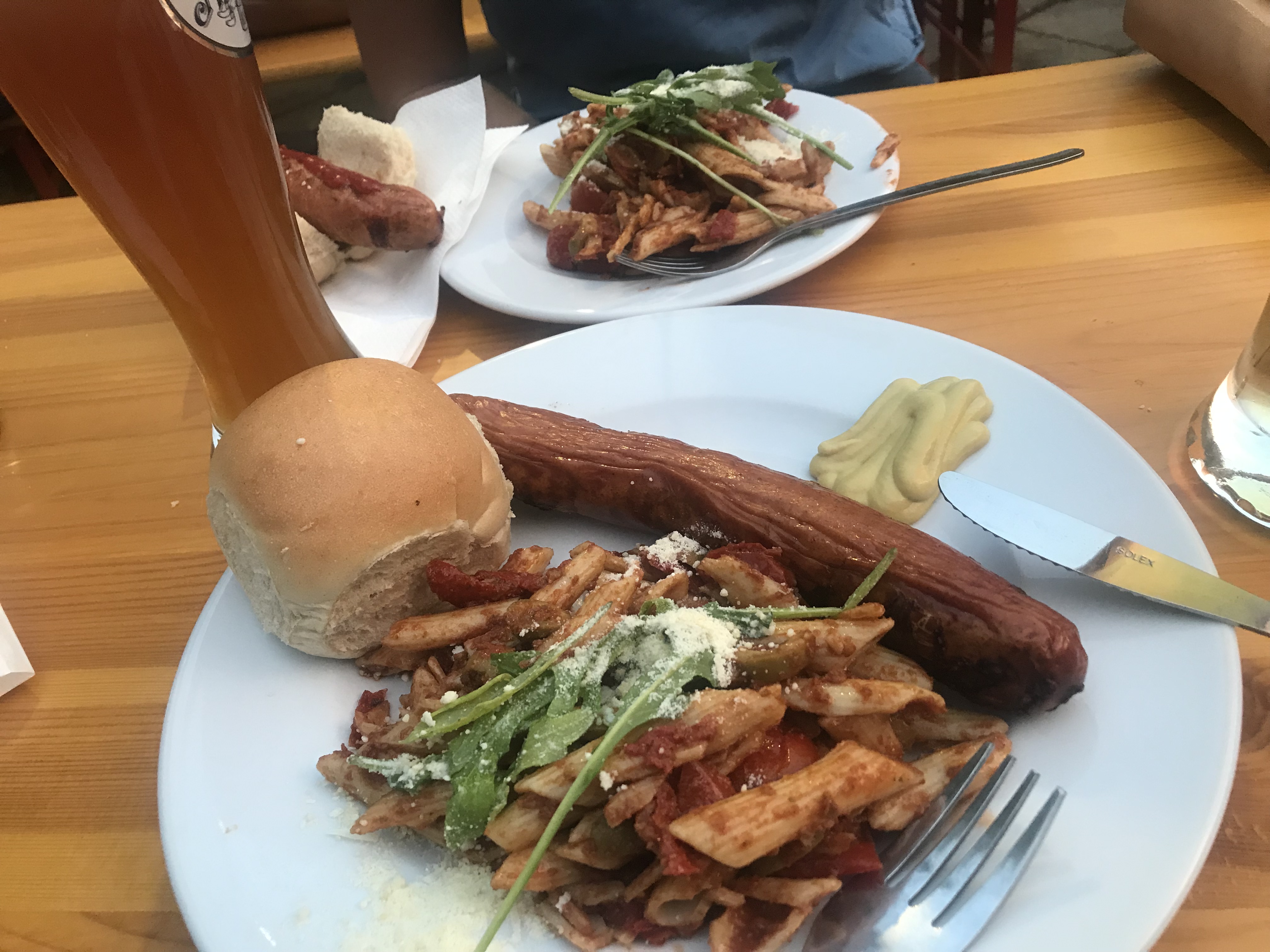
On Tuesday, May 21st, after a long flight from Chicago, Prater Garten was the obvious stop for dinner and beer. Previously in the day, a woman at the train station had suggested that we try Prater – stating that it was the oldest beer garden in Berlin. She had also remarked that they had fantastic German food such as “wurst” with sauerkraut and soft pretzels. Needless to say, expectations were pretty high, and we wondered if it would live up to the hype. After trying their noodle salad, spicy wurst, a soft pretzel, and multiple types of beer, we can certainly say that it did.

Above: a picture taken of our food… spicy sausage and noodle salad – the perfect complement to the wide selection of beer.

Prater Garten, established in 1837, was surely the perfect place to spend time with friends in a casual setting with great food and even better beer. The “Kristallweiss” bier, a light wheat beer, was particularly good – especially when paired with a warm, soft pretzel.

From the street, Prater Garden looks anything but exciting. A sign is hung from above, but no buildings can be seen. We entered under the passageway and were greeted by a winding pathway of motorcycles and bikes. The pathway took us behind a few fences, until finally the Biergarten revealed itself. Warm lights filled the atmosphere, and we could hear the chatter of many only seconds before we could smell the savory food being prepared. About 100 picnic benches were placed in rows and columns in a grassy area, also containing a small stage and a bright neon sign. People of all ages were seated and enjoying their meals. A mixture of German and English arose from the chatter, and it was obvious that the garden was frequented by locals and tourists alike. The employees at Prater are super and clearly appreciated any effort to speak German. You can definitely expect smiles (and probably some chuckles) as a result of attempting to use the language. The sausage and noodle salad was amazing, and it was paired with even better beer. The food could be considered 5 stars in my book, yet the atmosphere was even better with its casual and welcoming nature. All in all, Prater Biergarten was an amazing experience, and we’ll definitely be returning as soon as possible. Anyone looking for a relaxing evening filled with friends and beer should definitely add Prater into their itinerary.

A link to Prater Garten is placed below.

https://www.pratergarten.de

Blog by Adrianna Northrop and Elizabeth Wysession

The Journey Begins

LeipzigSpinnerei

Before living in Leipzig for four weeks to take an intensive course in German offered by the University of Leipzig’s InterDAF program, eleven MU students engaged with the history and the contemporary culture of Leipzig, Dresden, and Berlin. This blog is the result of their considerations, and can be thought of as both a diary of their experiences in Germany and as a project of cultural and historical map-making.