Dresden’s Semperoper

The Semperoper, the opera house in Dresden, was by far the most beautiful performance space I have ever seen. For me, as a lover of music and theatre, this is a fairly profound statement since I have been to many professional theatre spaces in both the USA and parts of Europe. Located in the center of the city, the Semperoper is a clear focal point of historic Dresden and the presence of opera in the city. Inside and out, the building is devastatingly breath taking. 

Pictured above: The Semperoper building

            While in Dresden, I had the privilege to take a tour of this beautiful facility. The tour was accessible to tourists since an English version of the tour was available. During my tour, I heard stories about the composers who worked there, how the opera house was built, and the paintings on the ceilings. Interestingly, I learned that most of the marble inside of the opera house is not actually marble. Instead, it is an architectural technique more expensive than marble itself. Additionally, a painting inside of the main auditorium and above the stage depicts many famous characters in opera and theatre. Unlike anything I had ever seen before, I found this work of art one of the most captivating aspects of the opera house. 

Notably, the composers Richard Wagner and Richard Strauss performed many of their works at the Semperoper. On my tour, I learned that Wager premiered many of his operas there. Some of Wagner’s famous premieres included the operas “The Flying Dutchman” and “Tannhäuser.”Today, the opera house is home to famous groups such as the Saxon State Opera, the Semperoper Ballett, and the Saxon State Orchestra. 

The Semperoper, built originally in 1841 has a both rich and fascinating history. Built initially by the acclaimed architect, Gottfried Semper, the opera house was rebuilt later by his son. After burning down in 1869, the building was reconstructed again by 1878. I was surprised to learn that this was not the last time the opera house faced reconstruction. In 1945, the opera house was destroyed yet again by bombs during World War Two and was not actually completed again until 1985. Due to its baroque appearance, it is dizzying to realize that most of the structure is actually fairly new. 

Taking the tour of the Semperoper is one of my favorite things I have done during this study abroad experience. Since embarking on this study abroad, I had wanted exposure to the obviously rich musical history surrounding me. My only regret is that I was not in Dresden long enough to see a performance there (as I was informed that one can buy a ticket for as little as $6!). I would highly recommend touring the Semperoper to anyone interested in music and theatre or even just architecture. I certainly hope that I can return some day and see an opera in this wonderful place. 

Pictured above: Me living my best life at the beautiful Semperoper!

The link to the Semperoper website is below. 

https://www.semperoper.de/

Blog by Adrianna Northrop

The World Clock – A Friendly Reminder of Interconnectedness

The World Clock is an iconic tourist destination that we felt was definitely worth seeing during our time in Berlin. It is located in Alexanderplatz among other popular tourist spots such as the Television Tower and an expanse of department stores. This makes it an optimal destination for tourists looking to experience the “must-sees” of Berlin.

Pictured above is the iconic World Clock. Behind it, the TV Tower can also be seen. This is a prime location for tourists in Berlin.

The idea to construct the clock came to be when the wreckage of the Uraniasäule (Urania’s Column), a street clock that sat in Alexanderplatz pre-World War 2, was found during restoration of the plaza in 1966. A contest was set up to create a replacement, and Erich John was the winner. Opened to the public on September 30th 1969, the World Clock is a truly unique and complex structure. The clock was designed by Erich John, but its construction required the help of more than 120 engineers and other experts to complete. It is 33 feet tall and weighs 16 tons. The clock is a constant reminder of the intense globalization present in the world today. It was constructed to reflect the 24 time zones (using UTC (Coordinated Universal Time)), each of which is listed circularly around it. Berliners and tourists alike can visit the World Clock and see the current time in 148 major cities. Above the listed times, a metal solar system sculpture made of steel rings and spheres revolves once a minute. The sculpture looks quite modern and is a further ode to the interconnected nature of countries around the world today. Another thing worthy of note is that it was not until some necessary repairs were made to the clock in 1997 that Tel Aviv and Jerusalem were added to the clock. Their initial omission was due to political sensibility surrounding Israel at the time.

We had learned about the World Clock in German class and were interested to see the structure in person. For those looking for things to do in Berlin, we would recommend taking a few minutes to check out the World Clock while in Alexanderplatz.

Blog by Adrianna Northrop and Kyle Hatten

Place of Information – a Place of Profound Understanding

Pictured above is the room exhibiting letters and writings from Holocaust victims. Their anger and confusion is apparent.

The Memorial to the Murdered Jews of Europe, located relatively close to the Brandenburg Gate and other important structures, is a large expanse of stone dedicated to the victims of the Holocaust. Beneath this centrally located memorial, however, is a haunting museum filled with real-life accounts of the Holocaust. This museum, called the Place of Information, shows personalized mementos and aspects of the the victims’ lives.

Completed in 2005, this museum is a profound representation of a dark time in German history and a must see for tourists who wish to know more about this. Due to their location near foreign embassies, the Bundestag, and the Brandenburger Gate, both the museum and the monument emphasize the omnipresence of the loss of Jewish life in German history and society.

Upon walking into the museum, the first room shows letters written by Holocaust victims to their families with translations made available – reminding the reader of their ultimate demise in German-run concentration camps throughout Europe. The letters, filled with pain and confusion, were devastating to read. This exhibit made sure to humanize and individualize many of the victims, which is an important perspective for the public to have. In our opinion, the best way to ensure history does not repeat itself is to make sure the people of the present understand the beautiful humanity lost to tragedy.

Another striking room was the Room of Families. This room featured photos of Jewish families, detailing individual members’ fates from the Holocaust. I spent the most time here, taking care to read each person’s fate. While many of the people listed in the room did survive, the overwhelming majority were murdered in the concentration camps. Seeing the faces of each victim was very emotional for me. This room featured information pertaining to only fifteen families, but this seemed like so much to me. Looking upon the faces of each family member, reading of their fate, and noticing how many small children had been killed in the Holocaust was absolutely nauseating. Despite the fact that only fifteen specific families were discussed in this room, I reminded myself that over six million people died at the hands of Nazis in the context of what we have come to call the Holocaust – more than the entire population of Los Angeles, California. This room showcased only a few of the victims lost in the Holocaust, and only a fraction of the families torn apart. The scale of the Holocaust was so much bigger than I could even imagine.

    I would highly recommend this museum. It is the perfect emotional complement to the Memorial to the Murdered Jews of Europe above it – allowing viewers of the memorial to better understand the gravity of each stone represented in the memorial. After going through this museum, I will always remember and respect the words and lives of those lost to the violence of the Holocaust. This, as I see it, is the best one can manage in the face of absolute tragedy.

Link to website: https://www.stiftung-denkmal.de/startseite.html

Blog by Adrianna Northrop and Katie Troha

Prater Garten – A Berlin Must!

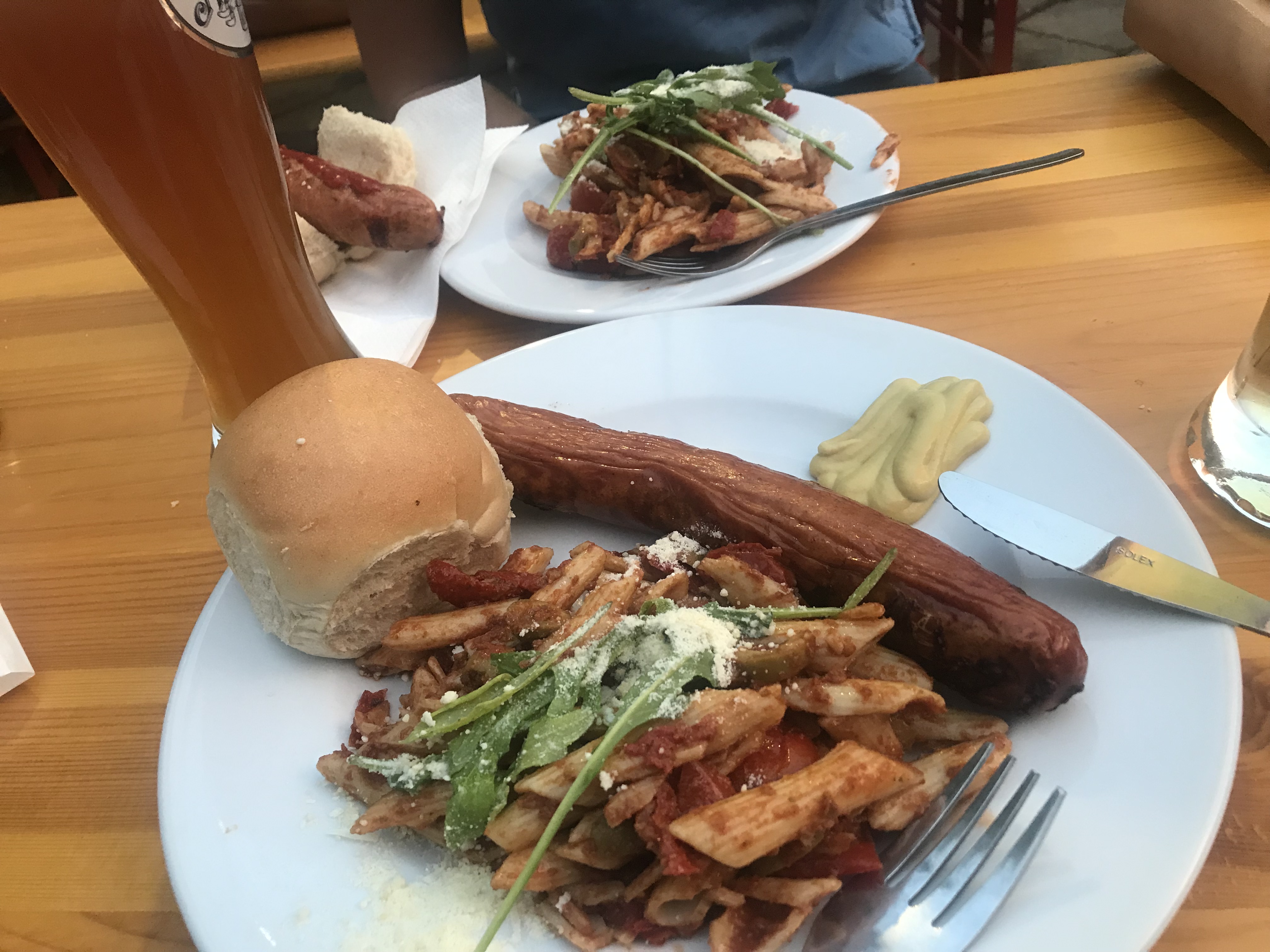
On Tuesday, May 21st, after a long flight from Chicago, Prater Garten was the obvious stop for dinner and beer. Previously in the day, a woman at the train station had suggested that we try Prater – stating that it was the oldest beer garden in Berlin. She had also remarked that they had fantastic German food such as “wurst” with sauerkraut and soft pretzels. Needless to say, expectations were pretty high, and we wondered if it would live up to the hype. After trying their noodle salad, spicy wurst, a soft pretzel, and multiple types of beer, we can certainly say that it did.

Above: a picture taken of our food… spicy sausage and noodle salad – the perfect complement to the wide selection of beer.

Prater Garten, established in 1837, was surely the perfect place to spend time with friends in a casual setting with great food and even better beer. The “Kristallweiss” bier, a light wheat beer, was particularly good – especially when paired with a warm, soft pretzel.

From the street, Prater Garden looks anything but exciting. A sign is hung from above, but no buildings can be seen. We entered under the passageway and were greeted by a winding pathway of motorcycles and bikes. The pathway took us behind a few fences, until finally the Biergarten revealed itself. Warm lights filled the atmosphere, and we could hear the chatter of many only seconds before we could smell the savory food being prepared. About 100 picnic benches were placed in rows and columns in a grassy area, also containing a small stage and a bright neon sign. People of all ages were seated and enjoying their meals. A mixture of German and English arose from the chatter, and it was obvious that the garden was frequented by locals and tourists alike. The employees at Prater are super and clearly appreciated any effort to speak German. You can definitely expect smiles (and probably some chuckles) as a result of attempting to use the language. The sausage and noodle salad was amazing, and it was paired with even better beer. The food could be considered 5 stars in my book, yet the atmosphere was even better with its casual and welcoming nature. All in all, Prater Biergarten was an amazing experience, and we’ll definitely be returning as soon as possible. Anyone looking for a relaxing evening filled with friends and beer should definitely add Prater into their itinerary.

A link to Prater Garten is placed below.

https://www.pratergarten.de

Blog by Adrianna Northrop and Elizabeth Wysession